Certificate of Analysis in Pharmaceutical Procurement: What US Buyers Should Review
Introduction
When US buyers source medicines, active pharmaceutical ingredients (APIs) or pharmaceutical products from overseas manufacturers, they need more than a supplier quotation and product specification sheet. They need good documentation that shows what was tested, what batch was tested and whether the results reported meet the applicable specifications. One of the most critical documents in this process is the Certificate of Analysis (CoA).
A pharmaceutical Certificate of Analysis is a batch-specific document that records the results of quality-control testing of a pharmaceutical product or material. It usually specifies the product, batch number, analytical methods, acceptance criteria, actual test results and quality approval. A thorough review of a CoA can help pharmaceutical distributors, importers and procurement teams in the United States spot discrepancies in documentation, assess the reliability of suppliers and make better-informed purchasing decisions.
But a CoA should never be judged in isolation. Buyers should also check the manufacturer’s identity, quality standards, regulatory requirements specific to the product, traceability and documents related to the shipment. This guide is designed to outline what a US pharmaceutical buyer should be looking for in a Certificate of Analysis before entering into an overseas pharmaceutical procurement transaction.
What Is a Certificate of Analysis in Pharma Sourcing?
A Certificate of Analysis is an official quality control document issued by a manufacturer or authorized testing laboratory reporting the analytical results of a given batch of pharmaceutical material or finished product.
It shows the relation between the tested batch and its quality specifications that have been established . A CoA will contain information on testing that is particular to a given batch, not the expected characteristics of a product as you would see on a general product specification sheet. A pharmaceutical specification sheet might say that an active ingredient must meet a particular purity requirement. The corresponding CoA reports the actual analytical result obtained for the batch under evaluation.
A typical pharmaceutical CoA might include:
- Name of product/material
- Manufacturer name and particulars.
- Lot or batch number
- Production and expiry dates if applicable.
- Pharmacopeial standard or reference specification.
- Analysis Methods.
- Acceptance standards.
- Real lab results.
- quality control approval.
- Date of the test and of the issuing document.
The FDA’s ICH Q7A guidance specifically addresses Certificates of Analysis for APIs including batch identification, testing requirements, acceptance limits, numerical results and authorized quality-unit approval.
Why Is a Certificate of Analysis Important for US Pharmaceutical Buyers?
There are a number of quality considerations in pharmaceutical procurement. Buyers want to be sure the products they are sourcing meet the specifications agreed upon for the transaction and that the supplier can provide reliable supporting documentation. A CoA helps procurement teams assess these factors.
1. Verifying Batch-Specific Quality Data
The manufacture and testing history of each batch of pharmaceutical product is unique. A CoA includes information about the specific batch being supplied rather than using general product descriptions. Buyers should ensure that the document mentions the precise batch number of the material delivered or tendered.
2. Reviewing Product Specifications
The document allows the buyer to compare actual laboratory results with applicable acceptance criteria. This is important because a simple statement such as “Passed” or “Complies” may not be enough for a useful technical review. Where numerical results are appropriate purchasers should examine the actual values and compare with the stated limits.
3. Backing Supplier Qualification
Complete and reliable batch documentation can also help when conducting a supplier evaluation. Buyers can examine previous CoAs for inconsistencies in documentation, unexplained deviations, or repeated quality issues. For API manufacturers the FDA’s ICH Q7A guidance covers evaluating the reliability of suppliers and periodically comparing full analytical results with supplier CoAs.
4. Procurement Traceability Improvement
A CoA links a tested batch to its product identity, manufacturer and quality records. Combined with purchase orders, packaging labels and shipping documents, it helps create a clearer record of what material is being purchased.
5. Support of Quality Risk Management
Missing information, unclear test methods or inconsistent batch details may indicate gaps in documentation that need to be investigated. When these issues are found before shipment, procurement and quality teams can make better-informed decisions.
What’s Included in a Pharmaceutical Certificate of Analysis?
There is not a universally applicable CoA template that can be applied to all pharmaceutical products. The information needed depends on the material, dosage form, relevant specifications, testing program and the regulatory context. However, U.S. buyers can use the following checklist when reviewing pharmaceutical quality documentation.
1. Identification of the Product and its Ingredients
First, check the product or material described in the certificate against what you have. Let me remind you:
- Generic name or material name.
- Strength or grade of product, if applicable.
- Formulation if Finished Pharmaceutical Product.
- Where applicable, product code or reference number.
- Manufacturer identification.
Product information must be consistent with the purchase order, supplier quotation and product documentation. If there is any difference in strength, formulation or product identity, this must be clarified before proceeding.
2. Batch/Lot Number
One of the most important elements in a pharmaceutical CoA is the batch number. It connects the analytical results to a particular manufacturing batch. Buyers should check the batch number against:
- Certificate of Analysis.
- Packaging and labeling of products.
- Batch release documentation.
- Applicable packing lists and shipping documents.
A CoA for another batch will not be accepted as evidence of testing for the batch supplied.
3. Manufacture Date, Expiry Date and Retest Date
The certificate should provide relevant dating information according to the product and material type.
| Information | What buyers should verify |
|---|---|
| Manufacturing date | Whether it matches the available batch records |
| Expiry date | Whether the stated expiry is consistent with product labelling |
| Retest date | Whether it applies to the material and is supported by the relevant quality documentation |
| Testing date | Whether testing relates to the identified batch |
| Release date | Whether the batch release information is available and consistent |
The ICH Q7A guidance for APIs from the FDA includes expiry and retest dating information on labels and CoAs.
4. Reference Standards and Specifications
A pharmaceutical CoA should specify the parameters to which the material or product was tested. Depending on the product, these could be:
- United States Pharmacopeia (USP-NF)
- Other pharmacopeial standards, recognized where applicable.
- Approved product specs.
- As per the manufacturer specifications.
- Customer specifications agreed.
Buyers should check that the standard referred to is applicable to the product and where applicable that the correct edition or version of the specification is used. The fact that a pharmacopeial standard is cited does not mean that all the necessary tests have been done.
5. Analytical Testing Methods
One quality parameter was measured in the laboratory and the analytical method describes how Buyers should look for identifiable means or references for the tests reported
Methods may include, depending on the material and test:
- High Performance Liquid Chromatography. (HPLC) .
- Gas Chromatography (GC)
- UV-Vis Spectrophotometry.
- Infrared spectroscopy (IR)
- Dissolution test.
- Microbiological examination.
The methods should be appropriate to the material and the test for which intended. In regulated pharmaceutical manufacturing, laboratory records are addressed by 21 CFR 211.194. These records include test methods, supporting data, calculations, and comparisons to established specifications.
6. Actual Test Results and Acceptance Criteria
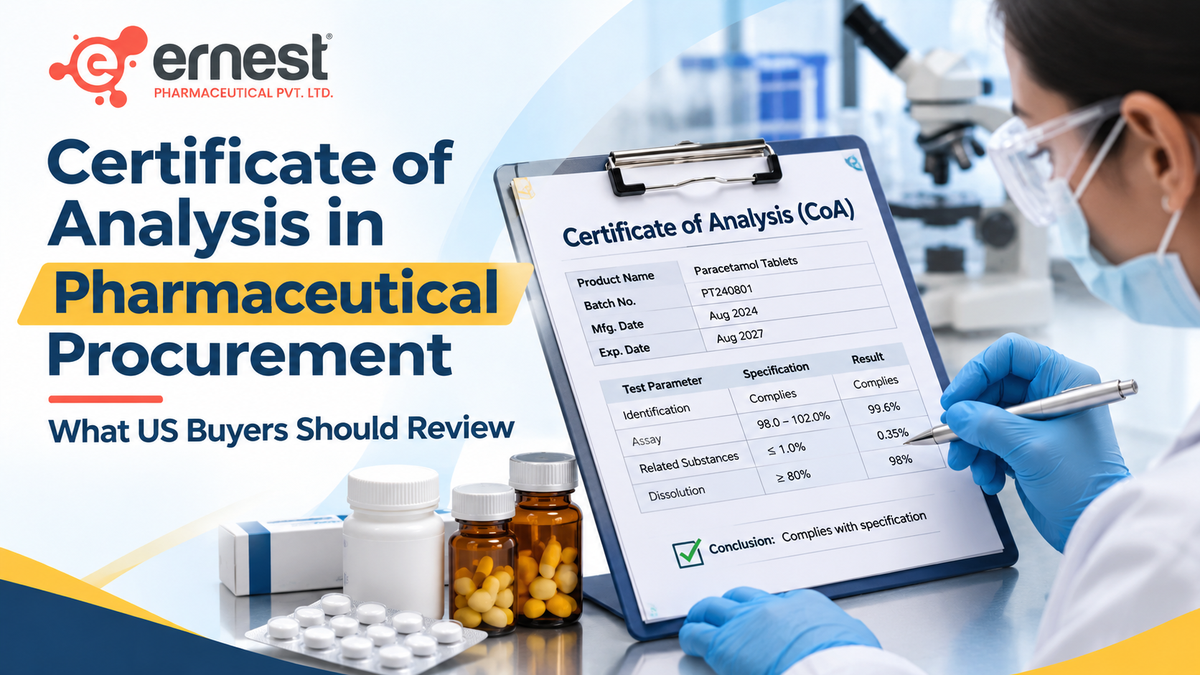
This is one of the most important parts of a pharmaceutical CoA. A good certificate should allow the reviewer to compare the acceptance criteria to the actual results. For example, consider this simplified illustrative format:
| Test parameter | Acceptance criteria | Illustrative result |
|---|---|---|
| Identification | Meets approved specification | Conforms |
| Assay | 98.0–102.0% | 99.60% |
| Related substances | Not more than 1.0% | 0.35% |
| Loss on drying | Not more than 0.5% | 0.20% |
Illustrative values only. These are not specifications or test results for any actual pharmaceutical product.
Buyers should question :
- Have all relevant tests been included?
- Are acceptance criteria defined?
- Are actual numbers given?
- Are the measurements in the same units ?
- Are the results within the applicable limits?
- Any unexplained deviations?
If the result of the test is to be reported then a simple “Pass” statement may not be sufficient for assessing a numerical test.
7. Quality-Control Approval and Authorized Signatures
Also, a CoA should include sufficient proof of quality unit approval. Buyers should consider:
- Name of issuing organization.
- Details of testing laboratory where applicable.
- Name and title of the authorized approver.
- Signature or electronic approval as appropriate.
- Date of approval.
- If applicable, the reference number of the document.
A signature does not in itself prove that the person was authorized to approve the batch. For APIs, FDA’s ICH Q7A guidance specifically addresses the dated and authorized CoA approval and identification of original manufacturer.
8. Information for Manufacturer and Lab
The original manufacturer and the laboratory where the analysis was performed should be identifiable. This is especially important when pharmaceutical products pass through distributors, traders, agents or repackers. Buyers should be aware of whether or not testing was done by a third-party lab:
If a third-party laboratory performed the testing, buyers should understand:
- Which organisation performed the analysis.
- Which organisation issued the certificate.
- Whether the original manufacturer is identified.
- Whether the testing laboratory's report can be verified.
- Whether the document references the original batch certificate where applicable.
The FDA's ICH Q7A guidance describes additional identification and traceability information in cases where certificates are issued by repackers, reprocessors, agents or brokers.
Pharmaceutical COA Checklist: A Practical Review for U.S. Buyers
The following checklist can help procurement and quality-assurance teams organise their review.
| Review area | What to check | Importance |
|---|---|---|
| Product identity | Correct name, strength and grade | High |
| Manufacturer | Original manufacturer's identity | High |
| Batch number | Matches supplied batch | Critical |
| Manufacturing date | Consistent with batch records | High |
| Expiry/retest date | Appropriate and consistent | High |
| Test methods | Relevant and identifiable | High |
| Specifications | Applicable acceptance limits | Critical |
| Actual results | Results available and within limits | Critical |
| Quality approval | Authorised signatory and approval date | High |
| Laboratory | Testing organisation identified | High |
| Traceability | Consistency with supporting documents | Critical |
| Document authenticity | Confirmed with the issuing organisation | Critical |
Before the decision of acceptance is made, the procurement team should record their findings and refer unresolved discrepancies to the appropriate quality or regulatory personnel.
What Pharmaceutical Tests Should Buyers Verify?
Tests shown on a Certificate of Analysis will differ based on product type, dosage form, specification and intended use. The testing requirements for a finished tablet, sterile injectable and active pharmaceutical ingredient are not necessarily the same. The following table provides examples of parameters that may be relevant.
| Test category | What it evaluates | Common application |
|---|---|---|
| Identification | Confirms material identity | APIs and finished products |
| Assay | Measures active ingredient content | APIs and finished products |
| Related substances | Evaluates specified impurities | APIs and finished products |
| Dissolution | Evaluates drug release | Applicable oral dosage forms |
| Disintegration | Evaluates tablet or capsule disintegration | Applicable dosage forms |
| Uniformity of dosage units | Evaluates dosage-unit consistency | Applicable finished products |
| Loss on drying / water content | Evaluates moisture-related characteristics | Applicable APIs and products |
| Microbial limits | Evaluates microbiological quality | Products where specified |
| Sterility | Evaluates sterility requirements | Sterile products |
| Bacterial endotoxins | Evaluates endotoxin levels | Applicable products |
Not every test is required for every product. The applicable specifications and approved testing programme should determine which parameters are relevant.
API vs Finished Product CoAs: What’s the Difference?
Procurement teams should not expect the same CoA checklist to be equally applicable to raw materials and finished medicines.
For active pharmaceutical ingredients:
Review identity, assay, impurities, relevant physical or chemical characteristics, moisture content if applicable and any other specifications specific to the API.
Finished drugs products:
Examine the appropriate requirements for the final dosage form, including identity, strength and relevant dosage-form testing (e.g. dissolution, uniformity or microbiological testing, where necessary). 21 CFR 211.165 addresses the testing of batches of finished pharmaceuticals against final specifications prior to release. Certain products such as sterile products and controlled-release dosage forms are also subject to special testing provisions.
How US Buyers Can Confirm a Pharmaceutical Certificate of Analysis
“Getting a CoA is just the start. Buyers should also check that the document is genuine and that the contents correspond to the material on offer.
Step 1: Get the Certificate from an Authorized Source
Ask the manufacturer directly for the CoA or request it from a documented, traceable supply chain contact. Don't rely on some anonymous PDF that has been forwarded through several hands.
Step 2: Confirm Batch Number
Verify the CoA batch number against the physical product label and the appropriate batch records. Any difference should be investigated.
Step 3: Check The Document With The Issuer
If possible, contact the issuing manufacturer’s quality department or laboratory using independently verified contact information. Check document reference, batch identity and approval status.
Step 4: Review the Test Information
Review analytical methods, specifications, acceptance limits and reported results. Ask the supplier to clarify missing methods, unclear units or incomplete results where necessary.
Step 5: Old Batch Record Comparison
If available compare with historical CoAs for similar products. Search for:
- A few inconsistencies in the documentation.
- Large unexplained variations in results.
- Modifications of analytical methods or specifications.
- Manufacturer/laboratory details not explained.
Differences don't automatically mean a failure in quality but can be a cause to investigate.
Step 6: Review of Quality Supporting Documents
Request relevant supporting records depending on the product and transaction such as:
- Batch manufacturing or batch release records.
- Product specifications that apply.
- Stability data.
- Manufacturing site information.
- Adequate GMP Documentation.
- Reports to laboratory when necessary.
Step 7: Record the Procurement Decision
Results of the document review, open questions and any further verification performed. The organization shall make quality-related acceptance decisions in accordance with the organization’s proper quality procedures.
Common Red Flags in Pharma COA Documentation
US pharmaceutical buyers should pay attention to inconsistencies that may affect the reliability of a certificate.
| Potential red flag | Why it matters | Recommended action |
|---|---|---|
| Batch number mismatch | Document may relate to another batch | Request clarification and matching documentation |
| Missing manufacturer details | Original source may be unclear | Verify the manufacturing entity |
| No actual results | Limited ability to evaluate testing | Request complete analytical information |
| Missing test methods | Testing cannot be adequately assessed | Request method references |
| Unclear acceptance limits | Compliance cannot be properly compared | Request the applicable specifications |
| Unauthorised approval | Release responsibility is uncertain | Confirm the authorised quality approver |
| Inconsistent dates | May indicate incorrect or incomplete records | Request corrected and verified documents |
| Unidentified third-party laboratory | Testing responsibility is unclear | Verify the laboratory and original report |
| Altered or inconsistent formatting | Document integrity may require investigation | Authenticate the certificate with its issuer |
Important: A discrepancy in the documentation does not automatically establish that a pharmaceutical product is defective or fraudulent. But this should be sorted out before the quality decision is taken.
What a Certificate of Analysis Doesn't Show
A CoA is commonly mistaken in pharmaceutical procurement as full proof of regulatory compliance ,It isn't. A CoA gives analytical information about the identified batch. It does not independently verify the regulatory status of all aspects of the product or suitability of the supplier.
A CoA alone is not proof of:
- That the supplier has the right to manufacture or sell the product.
- That the manufacturing facility is in compliance with all applicable regulatory requirements.
- That the product has an approved marketing application where an application is required.
- That the product may legally be imported into the United States.
- That the product was transported under the necessary storage conditions.
- That the physical contents of the shipment match the certificate.
- That the product is suitable for any particular market or commercial purpose.
Buyers should consider the relevant supporting evidence on a case by case basis.
Understanding FDA Requirements for Imported Pharmaceutical Products
The FDA reviews imported human drugs to determine whether they meet applicable requirements which may include:
- Registration of foreign establishment.
- Listing of drugs.
- Drug application requirements applicable.
- Drug labeling requirements.
- Current Good Manufacturing Practice (CGMP).
The FDA also reviews information in import entry transmissions, including manufacturer, importer or consignee, product description, and applicable compliance information. If the declarations are wrong or incomplete, this may delay the review or cause detention. For U.S. buyers, this means pharmaceutical quality documentation and import compliance are related, but separate areas of due diligence.
A passing CoA does not replace the regulatory review required for the specific product and import transaction. Refer to the FDA's Importing Human Drugs guidance.
How FDA CGMP Requirements Relate to Pharmaceutical Quality Documentation
U.S. pharmaceutical buyers need to know the difference between a supplier’s CoA and the underlying lab records that are maintained under applicable CGMP requirements.
21 CFR 211.194 Laboratory Records.
This regulation applies to laboratory records of tests on pharmaceutical products and materials. It contains information about :
- Sample identification and source
- Batch or lot number.
- Testing techniques.
- Full test data.
- Calculations.
- Results : comparison with specs and actual results.
- Personnel to be tested.
- Independent review of source records.
These requirements provide an important background to appreciate the need for complete and traceable laboratory documentation.
21 CFR 211.165 – Testing and Approval for Distribution
This provision pertains to the laboratory testing and release of finished drug products. It requires, subject to specific provisions in the regulation, each batch to be tested against final specifications, including the identity and strength of active ingredients, before release. It also covers the microbiological testing as needed and the rejection of products not meeting the set standards.
API Quality Documentation - FDA ICH Q7A Guidance
The FDA has specific recommendations for CoAs in its ICH Q7A guidance for active pharmaceutical ingredients. It talks about
- Authentic certificates for every batch.
- PRODUCT OR MATERIAL IDENTITY
- Batch number and date of release.
- Expiry or re-test dates.
- Tests performed and acceptance criteria.
- Numerical tests results.
- Authorized Signatories .
- Original manufacturer identification and laboratory identification.
It also includes the assessment of supplier reliability and the regular comparison of analytical results with the supplier’s CoAs. These references shall be applied within the scope of their application. API guidance should not be used as a blanket replacement for the requirements that apply to finished pharmaceutical products.
How Pharmaceutical Distributors Can Improve COA Review Process
CoA review should be a defined part of supplier qualification and purchasing procedures for US distributors and procurement organizations sourcing from overseas suppliers. The following practices can help create a more consistent process:
Develop a Standardized Documentation Checklist
Prepare a checklist having product identity, batch details, testing methods, results, approval details and document authenticity. Procurement teams can easily identify missing information and the review process is standard.
Keep Records of Supplier Documents
Keep records of supplier qualification, applicable quality documentation, previous CoAs and resolved discrepancies. Historical data can be used to evaluate supplier performance.
Technical Reviews should include Quality Assurance
Procurement teams may identify commercial and documentation issues but technical decisions involving specifications, analytical results and batch acceptance should be reviewed by qualified quality personnel.
Review Documents Before Shipping
Where commercially and operationally possible, request and review batch-specific relevant documentation prior to shipment. This provides an opportunity to clarify missing information prior to the goods entering the import process.
Retain Batch Traceability
Trace purchase orders, CoAs, packaging details and shipping records back to the same product and batch. Good documentation practices assist in later investigations and supplier communications.
How to Evaluate an Overseas Pharmaceutical Vendor Beyond the CoA
To ensure a robust pharmaceutical procurement process, more than a review of a single quality document is required. US distributors should evaluate the supplier's overall documentation and supply-chain arrangements.
| Evaluation area | What buyers should investigate |
|---|---|
| Manufacturer identity | Original manufacturing entity and site |
| Supplier relationship | Whether the supplier is a manufacturer, distributor, agent or repacker |
| Quality documentation | Availability and consistency of batch-specific CoAs |
| GMP information | Relevant manufacturing quality evidence |
| Product specifications | Applicable standards and approved specifications |
| Regulatory documentation | Product-specific US regulatory requirements |
| Traceability | Ability to connect batches with supporting records |
| Communication | Ability to respond to technical and documentation queries |
| Logistics | Applicable storage and transportation conditions |
An overseas supplier should be able to explain the origin of the product, identify the responsible manufacturing entity and provide relevant supporting documentation. Buyers need to check these details for themselves, not just accept marketing statements or general claims from a supplier at face value.
Frequently Asked Questions (FAQs)
1. Certificate of Analysis in Drug Procurement What is a Certificate of Analysis?
A Certificate of Analysis is a batch-specific quality document issued by the manufacturer or testing laboratory. It contains the results of relevant analytical tests and compares them with the established product or material specifications.
2. What should a COA for pharmaceuticals include?
A pharmaceutical CoA should normally specify the product, manufacturer, batch number, applicable specification, testing methods, acceptance criteria, actual results and authorized approval details. Other information depends on product and quality requirements applicable.
3. Does every pharmaceutical product imported into the USA require a Certificate of Analysis?
No one size fits all rule that all pharmaceutical imports must have the same standalone CoA format. Documentation requirements will depend on the product, applicable regulations, manufacturing controls and transaction. Buyers should work with their quality and regulatory teams to define specifics.”
4. How do US pharmaceutical buyers verify a supplier’s CoA?
Buyers can verify the document by manufacturer, laboratory, batch number, test methods, acceptance criteria, actual results and authorized approval . They should also check the certificate with the issuing organization and cross check it with relevant batch and shipment documentation.
5. What is the difference between a CoA and a product spec sheet?
A product specification sheet lists the desired quality characteristics of a product and the acceptable limits. The Certificate of Analysis contains the actual test results for a given lot against the appropriate specifications.
6. A Certificate of Analysis is not proof that a medicine has been approved by the FDA.
No. A CoA gives the analytical results for a specific batch. It is not FDA approval, marketing authorization, establishment compliance or legal eligibility for import. The requirements will have to be evaluated separately depending on the product and its intended use.
7. What tests should buyers watch for in a pharmaceutical CoA?
Relevant tests depend on product They may include tests for identity, assay, impurities, dissolution, disintegration, uniformity of dosage units, moisture content, microbial limits, sterility or bacterial endotoxins, where applicable.
8. What is the importance of batch number verification in the review of pharmaceutical quality documents?
The CoA is linked to a specific manufactured lot via the batch number. It’s a bit like checking the packaging labels and supporting documents, to make sure of traceability and to reduce the risk of relying on test results from another batch.
Conclusion
A Certificate of Analysis is an important part of pharmaceutical procurement because it provides batch-specific information about the quality testing performed on a pharmaceutical product or material. For US pharmaceutical buyers, reviewing a CoA should involve more than checking whether the document says "Passed". Procurement teams should evaluate product identity, batch traceability, analytical methods, acceptance criteria, actual test results, manufacturer details and authorised quality approval.
They should also understand that a CoA is only one part of a broader supplier qualification and regulatory review process. By establishing a consistent documentation review procedure and verifying supporting records, pharmaceutical distributors, importers and procurement professionals can make more informed sourcing decisions when evaluating overseas suppliers.
For pharmaceutical procurement, reliable documentation, transparent communication and appropriate quality verification should remain central to every supplier relationship.
Connect with Ernest Pharmaceuticals
Ernest Pharmaceuticals Pvt. Ltd. is an India-based pharmaceutical business with a portfolio of branded and generic medicines and international pharmaceutical supply partnerships.
For B2B pharmaceutical product enquiries, sourcing discussions or information about available product documentation, contact the Ernest Pharmaceuticals team.
Email: exports@ernestpharmaceuticals.com
Enquiry: https://www.ernestpharmaceuticals.com/enquiry.php
This article is intended for general pharmaceutical procurement education. It does not constitute legal, regulatory or quality-assurance advice. Buyers should consult qualified regulatory and quality professionals for product-specific decisions.
References
- FDA – ICH Q7A GMP Guidance for APIs: https://www.fda.gov/regulatory-information/search-fda-guidance-documents/q7a-good-manufacturing-practice-guidance-active-pharmaceutical-ingredients
- 21 CFR 211.194 – Laboratory Records: https://www.law.cornell.edu/cfr/text/21/211.194
- 21 CFR 211.165 – Testing and Release: https://www.law.cornell.edu/cfr/text/21/211.165
- FDA – Importing Human Drugs: https://www.fda.gov/industry/importing-fda-regulated-products/importing-human-drugs