
Pharmaceutical Shipping Documents for UK Wholesale Buyers
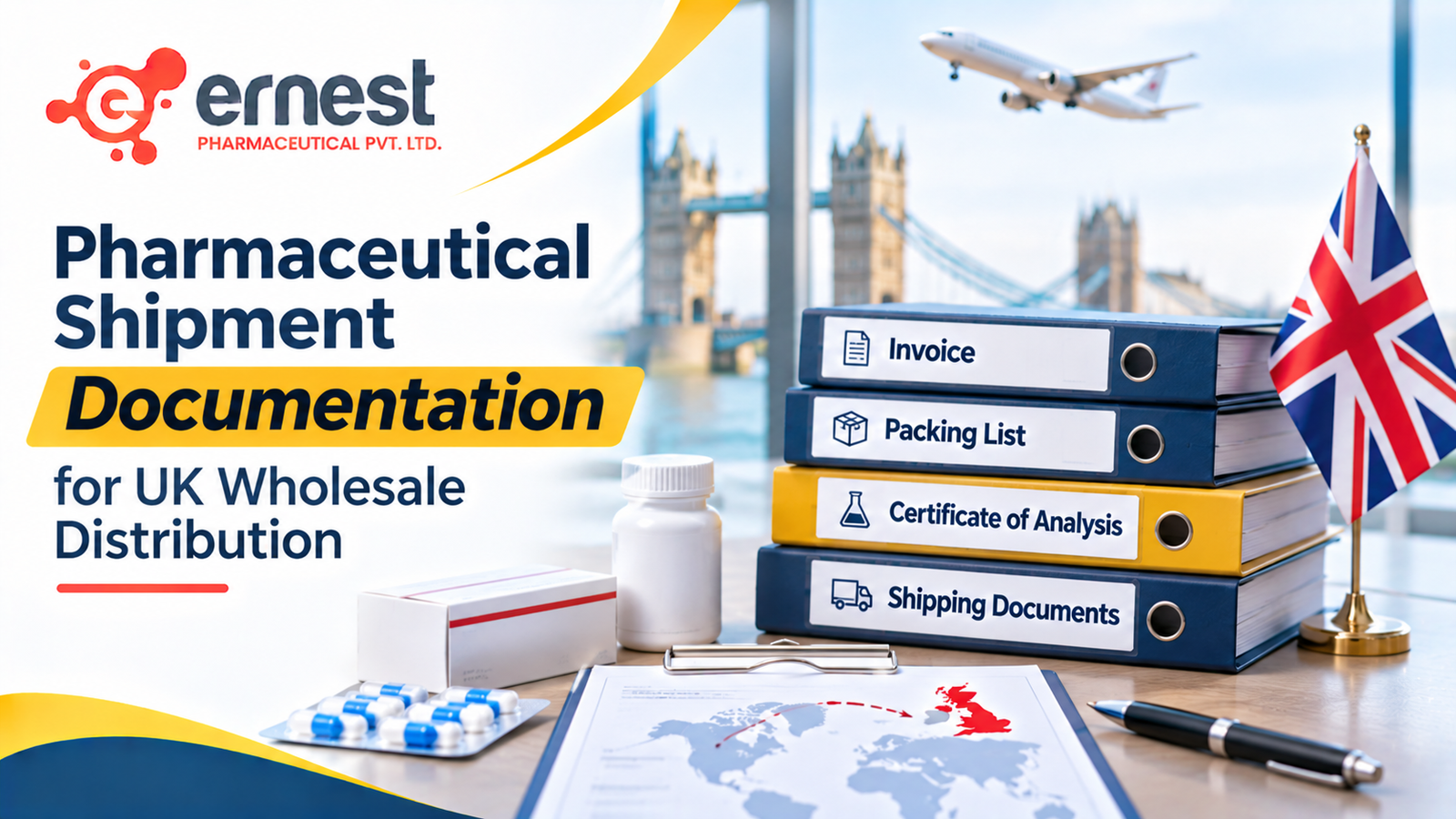
Pharmaceutical Shipment Documentation for UK Wholesale Distribution
Introduction
Pharmaceutical shipments involve more than moving medicines from one location to another. Every order must be supported by accurate commercial, shipping, product and quality records. For UK wholesalers and distributors, these documents help confirm what has been supplied, identify the relevant batches, support receipt checks and maintain visibility across the medicine supply chain.
Understanding pharmaceutical shipping documents UK requirements is important for buyers working with domestic suppliers as well as international exporters. Missing paperwork, inconsistent product details or unclear batch information can create delays, complicate goods-in checks and make it harder to investigate a delivery discrepancy.
The exact documents required depend on the medicine, country of origin, import route, parties involved and intended distribution activity. Commercial shipping documents do not replace regulatory authorisations or quality records. Buyers should review both categories before dispatch.
This guide explains the main pharma wholesale distribution documents UK buyers may need to request, check and retain, and how these records support a more controlled medicine supply chain.
1. Commercial Documents for Pharmaceutical Shipments
Commercial documents record the details of a transaction between seller and buyer. They also assist the purchasing, finance, logistics and warehouse teams to confirm that the shipment is what was ordered.
Typical documents include:
Purchase Order Form
A purchase order records what the buyer has agreed to buy. It provides a reference against which the supplier’s invoice, packing list and delivered goods can be verified.
A pharmaceutical purchase order must clearly include:
- The product name and, if applicable, the generic name or brand name.
- Strength and form of dosage.
- Packaging size and presentation.
- Amount ordered.
- Agreed on currency and price.
- Details of the supplier and buyer.
- Delivery location and the delivery terms agreed upon.
- Outstanding specific documentation or shelf-life requirements.
It is especially important that product descriptions are clear when medicines have similar names but different strengths or presentations.
Trade Invoice
The commercial invoice indicates the value and describes the goods to be supplied. It is an important commercial document and may also be required for customs when a shipment crosses an international border.
Buyers should check that the invoice contains:
- The seller and the buyer’s legal names and addresses.
- Invoice date and number.
- Description and quantity of products.
- Unit price and total value of shipment.
- Applicable fees and currency.
- Country of origin (where applicable).
- Details of relevant purchase order or shipment.
The goods must be stated correctly in the invoice. If the product details or quantities are different from the purchase order, the difference should be clarified before the shipment proceeds.
Packing List
A packing list details how the goods are packed and arranged inside the shipment. It helps warehouse and receiving teams identify packages and match the physical delivery to the supplier’s records.”
It can consist of:
- Quantities and product descriptions.
- Number of cartons or packages.
- Package identification or marking.
- Gross and net weight, if stated.
- Dimensions & packaging.
- reference to the shipment or purchase order
Packing list does not replace product quality documentation. Used for the physical identification and verification of the consignment.
2. Shipping & transport documents
The movement of pharmaceutical goods is described in the transport documents. The document used varies according to the mode of transport , arrangement of shipment and contractual terms .
Airway Bill
Air freight is usually done with an Air Waybill (AWB). It contains important information about the consignment and the parties to its carriage.
Buyers are advised to check the following details (where applicable):
- Details of the shipper and the consignee.
- Departure and destination airports.
- Reference number for shipment.
- Weight and number of packages
- Description of goods.
- Carrier information and handling information.
The AWB helps identify and track the air cargo. It does not, in itself, prove that the medicine is authorized for sale or distribution in the UK.
Bill of Lading
In sea freight, a Bill of Lading is used to record details of the goods received for carriage and the agreed transport arrangement. Depending on the type of document and the transaction, it can also be a document of title.
The relevant details may include:
- The shipper and the consignee.
- Vessel and voyage details.
- Place of loading and unloading.
- Number of packages and description.
- Container and seal numbers as applicable.
- Mentions of freight and shipments.
Buyers should ensure that the information matches the commercial invoice and packing list.
Delivery Note
For road transport, a consignment note may contain the name of the sender and receiver, description of the goods, place of collection and delivery, and carrier details. The CMR consignment note is most commonly used for international road carriage where the CMR Convention applies.
The receiving team can use these records to identify the delivery and investigate any missing or damaged packages.
3. Batch and Product Documentation
Commercial and transport documents: they describe the transaction and movement of goods. Product and batch records contain more detailed information about the medicine itself.
These records are especially important for pharmaceutical wholesalers because medicines need to be traceable through the storage and distribution processes.
CoA (Certificate of Analysis)
A Certificate of Analysis, where issued, provides test results and quality information for a particular product batch. The buyer may require that the batch be checked against the specifications stated.
When checking a CoA consider:
- Product name and strength
- Lot or batch number.
- Manufacturer information.
- Test parameters and results reported.
- Relevant specifications or acceptance criteria.
- Date of the document and issuing organization.
The batch number on the CoA must match the batch being supplied. A CoA is a useful indicator of quality but it does not substitute a marketing authorization, an import licence or any batch certification that may be required.
Batch and Expiry Information
Batch information helps to identify and trace the product. Buyers are encouraged to request and/or verify pertinent batch details before accepting a shipment.
Key information includes:
- Lot or batch number
- Date of manufacture, if present.
- expiry date
- Name of product manufacturer or owner.
- Name of product, strength and dosage form.
The information used to identify the product delivered, its packaging and any supporting records should be consistent. All discrepancies must be investigated prior to goods being released into salable stock.
Read Ernest Pharmaceuticals' guide to medicine procurement quality checks and cost control to learn more about supplier checks and traceability.
Product Specifications & Support Information
Depending on the product and the transaction, buyers may also require product specifications, approved product information, packaging details or other technical records.
The documents may help to confirm that the supplied medicine meets the agreed requirements. Buyers should know what records are relevant to the product in question, and not assume that there is one standard set of documents for all medicines.
4. Import and Regulatory Documentation for UK Distribution
When importing medicines into the UK, buyers need to think about which regulatory route applies, in addition to the commercial paperwork. Requirements may vary depending on the product, the country of origin, the authorization status and the activities undertaken by the importing business.
The UK Government has issued guidance on importing a human medicine which details the licensing framework for different import activities.
Depending on the transaction, the following records or proof may be applicable:
Wholesale Distribution Authorization (WDA(H))
A Wholesale Distribution Authorization is relevant to businesses carrying out wholesale distribution activities in respect of human medicines. Buyers should verify that the relevant organization is appropriately authorized for the activities it undertakes.
A WDA(H) should not be taken to mean that all types of medicines can be imported as a matter of course. The product and route determine the applicable licensing requirements.
Manufacturer/Importer License
Some activities related to the importation and manufacture of medicines require a Manufacturer’s/Importer’s Licence. Buyers need to verify who is responsible for the import and whether the correct authorization is in place.
Details of Marketing Authorization
The marketing authorization status of the medicine is an important part of the check on whether a medicine can be placed on the relevant market. The product identity, strength, dosage form and presentation should be cross referenced with the applicable authorization.
The fact that a product is legally marketed in its country of origin does not necessarily mean that it can be supplied through all distribution routes in the UK.
Proof of Batch Certification and Release
Where the applicable import route requires it, buyers or responsible parties may need to have evidence of Qualified Person (QP) certification or other relevant batch release checks.
The evidence has to be on the right product, the right batch. Do not assume that a generic quality statement from a supplier or a CoA is a replacement for the required certification.
Country of Origin and Country of Import Records
The country from which a medicine is sourced may also have an impact on regulatory requirements. UK purchasers must check the current MHRA guidance on sourcing medicines for the UK market and confirm the applicable route.
In some areas Great Britain and Northern Ireland may have different arrangements. Buyers must identify the destination market before they can rely on a certain set of requirements.
To read Ernest Pharmaceuticals’ B2B guide to importing medicines into Great Britain for a deeper look at licensing and import-route considerations.
5. Documentation of Temperature and Storage
Some medicines need special handling in storage and transport to maintain their quality. For these products, shipment planning should include appropriate handling arrangements and appropriate supporting documentation.
The documentation needed will be determined by the approved storage conditions of the product and the distribution agreement.
Buyers may need to check:
- Instructions for product storage.
- Conditions of storage and transport.
- Temperature monitoring records where applicable.
- Reports of temperature excursions, if a deviation occurs.
- Packaging/shipping system information.
- Records of deliveries and handovers.
- Procedures to investigate and report deviations as appropriate.
The temperature records come in handy especially when a product is required to be within a certain temperature range while in transit. Buyers should clarify how monitoring will be done, who will review the records and how any excursion will be assessed.
The UK’s Good Manufacturing Practice and Good Distribution Practice guidance, which covers the reasons why medicines must be stored, transported and handled correctly.
GDP is not restricted to warehouse conditions. It also relates to the procurement, transport, storage and supply of medicines through the distribution chain.
6. Customs and Import Paperwork Assistance
Another key element of the process for international pharmaceutical shipments is customs documentation. The exact requirements vary depending on the goods, origin, destination, customs procedure and parties involved.
Supporting paperwork may include: Depending upon the shipment:
- Information on customs declarations.
- Commercial invoice
- List of packing.
- Transport document, e.g., AWB or Bill of Lading.
- Proof of country of origin (where applicable).
- Relevant licenses, permits or regulatory support documentation;
- Other product-specific information requested by the competent authorities.
Buyers should liaise with your customs representative or freight forwarder to confirm the documents and information required for the particular shipment.
The description, quantity, value and origin information should be consistent between the relevant records. Incorrect or incomplete information may result in customs questions and delays.
Another thing to think about is that customs clearance and permission to put a medicine on the market are two different things. The mere completion of customs formalities is not in itself proof that all requirements of pharmaceutical regulations have been met.
7. Document Checks Pre-Shipment and Post-Delivery
A constant review process of documents allows buyers to identify problems before they reach the supply chain. Checks should be done at more than one stage rather than when the goods get here.
Prior to Dispatch
Buyers should . . . • Before the shipment is released, the supplier should:
- Check supplier invoice against the confirmed purchase order.
- Check packing list and expected number of packages.
- Confirm product name, strength, dosage form and quantity.
- Request available batch and expiry details.
- Review the applicable CoA and supporting records for the product.
- Find out which import and regulatory documents apply.
- Organize transportation and storage.
- Clarify how missing documents or discrepancies will be resolved.
Upon Receiving Goods
Once the shipment arrives the receiving team should:
- Verify received packages against the packing list.
- Compare received products with purchase order and invoice.
- Look for batch numbers and expiry details.
- Check the packaging for any signs of damage or tampering.
- Review temperature records if applicable.
- Document discrepancies, damage or record shortages.
- Hold or escalate questionable goods in accordance with the organization’s procedures.
During Storage & Distribution
Documentation responsibilities remain upon receipt. Traceability, stock control and the investigation of complaints or recalls should be supported by relevant records.
Businesses shall keep appropriate records of receipt, storage, supply and distribution in accordance with the requirements relevant to their activities.
8. Documentation: Common Mistakes to Avoid
Even if a shipment has the right commercial documents, issues can arise from inconsistencies or missing product records.
Typical problems are:
- Product descriptions not matching between the purchase order, the invoice and the packing list.
- Batch number incorrect or missing.
- Expiry dates not in line with buyer’s agreed requirements
- A CoA relating to a different batch.
- No transport or delivery references provided.
- Responsibility for obtaining documents related to import unclear.
- Temperature logs for monitored products are incomplete.
- Customs clearance required to be eligible for pharmaceutical market.
- Using a generic supplier certificate instead of product-specific regulatory proof.
Many of these problems can be avoided by having a document checklist agreed between buyer and supplier. It should identify the expected documents, who will provide them and when they should be available.
9. Trustworthy Documentation Powers Medicine Supply Chain
Accurate records are more than just an administrative compliance issue. They allow different teams to work from a consistent set of information and make it easier to investigate problems.
Documentation that is well-organized can help pharmaceutical wholesalers with:
- Product identification: Clear descriptions assist in differentiating medicines with similar names, strengths or presentations.
- Batch traceability: Batch and expiry details enable businesses to trace back affected stock if there is a quality issue.
- Inventory control: Assists in stock reconciliation with actual quantities and product details.
- Coordination of deliveries: Transport records allow teams to track shipments and look into delays.
- Quality oversight: Records of product and temperature for review of storage and handling.
- Communication with suppliers: Standard documents make it easier to resolve discrepancies with suppliers and logistics partners.
Ernest Pharmaceuticals provides details of its pharmaceutical product range and company background on its About Us page. Potential buyers should check product availability, applicable documentation and destination-market requirements for their particular inquiry, including a potential supply arrangement.
10. Conclusion
Pharmaceutical shipment documentation is a key part of responsible wholesale distribution in the UK. Commercial records prove what has been bought and supplied. Transport documents assist in the tracking of goods. Product and batch records aid identification and traceability.
Buyers are also responsible for relevant import, customs and regulatory requirements for international shipments. The exact pharmaceutical shipping documents UK buyers will require will depend on the medicine, supply route and organizations involved. Different shipments will not need the same set of documents.
One practical approach is to agree on requirements for documentation before dispatch, to compare records at receipt of goods and to retain appropriate information throughout storage and distribution. This helps wholesalers and distributors better manage discrepancies and support a reliable medicine supply chain.
Contact Ernest Pharmaceuticals for product or business inquiries and to discuss their requirements.
FAQs
1. What pharmaceutical shipping documents should UK wholesalers check?
The purchase order, the commercial invoice, the packing list and the appropriate transport document are typical documents. Depending on the medicine and supply route, buyers may also request batch details, a Certificate of Analysis, relevant regulatory evidence and temperature records.
2. Is a commercial invoice enough for importing medicines into the UK?
No. A commercial invoice records the commercial details of a transaction but does not replace applicable medicine import licences, product authorization requirements, batch certification or other regulatory evidence. Buyers need to check the requirements for the particular product and route of import.
3. What is the purpose of a pharmaceutical packing list?
A packing list is a list of the packages and goods contained in a shipment. It helps the receiving teams to compare the physical receipt with the supplier’s records, identify quantities of packages and investigate any shortages or discrepancies.
4. Why is Certificate of Analysis Important in Pharma Distribution?
Where issued and applicable, a Certificate of Analysis will provide batch-specific testing results and quality information. It can be used by buyers to verify that the document applies to the product and batch being supplied. It is not a substitute for batch certification and regulatory authorizations needed.
5. Are temperature monitoring records required for all pharmaceutical shipments?
Not always. The requirements on temperature monitoring depend on the storage conditions of the medicine, the product specifications and the transportation arrangements. Where monitoring is required, buyers should agree on how records will be created, reviewed and retained.
6. What are the differences between shipping documents and regulatory documents?
Shipping documents describe the commercial transaction and physical movement of goods . Regulatory documents substantiating legal authorization, import activities or required quality and batch controls. Whether a shipment requires both categories depends on the product and the supply route.
7. How should UK wholesalers react to missing or incorrect shipment documentation?
Any discrepancies should be noted and the supplier or responsible party informed. The buyer’s internal quality and goods receipt procedures, including any applicable hold or escalation process, should be followed. The physical shipment has arrived, but it doesn't mean that questionable products should be considered acceptable.
8. How long should pharmaceutical wholesale distribution records be kept?
The retention period for records depends on the relevant legislation and regulations and the type of record. Wholesale distributors shall comply with the current requirements applicable to their authorization and activities and shall keep procedures to ensure the accessibility of records for inspection, traceability and investigations.