How to Compare Pharmaceutical Supplier Quotations: UK Guide
How to Compare Pharmaceutical Supplier Quotations – A Guide for UK Buyers
Introduction
Comparing pharmaceutical supplier quotations is an important part of purchasing medicines for UK wholesalers, distributors, pharmacies, hospitals and healthcare procurement teams. However, selecting a supplier based only on the lowest quoted price can lead to unexpected costs, delivery problems or documentation gaps.
Two suppliers may offer what appears to be the same medicine, but their quotations may differ in product specifications, manufacturer, pack size, remaining shelf life, order quantity, shipping arrangements and payment conditions. These differences can affect the actual value of an offer.
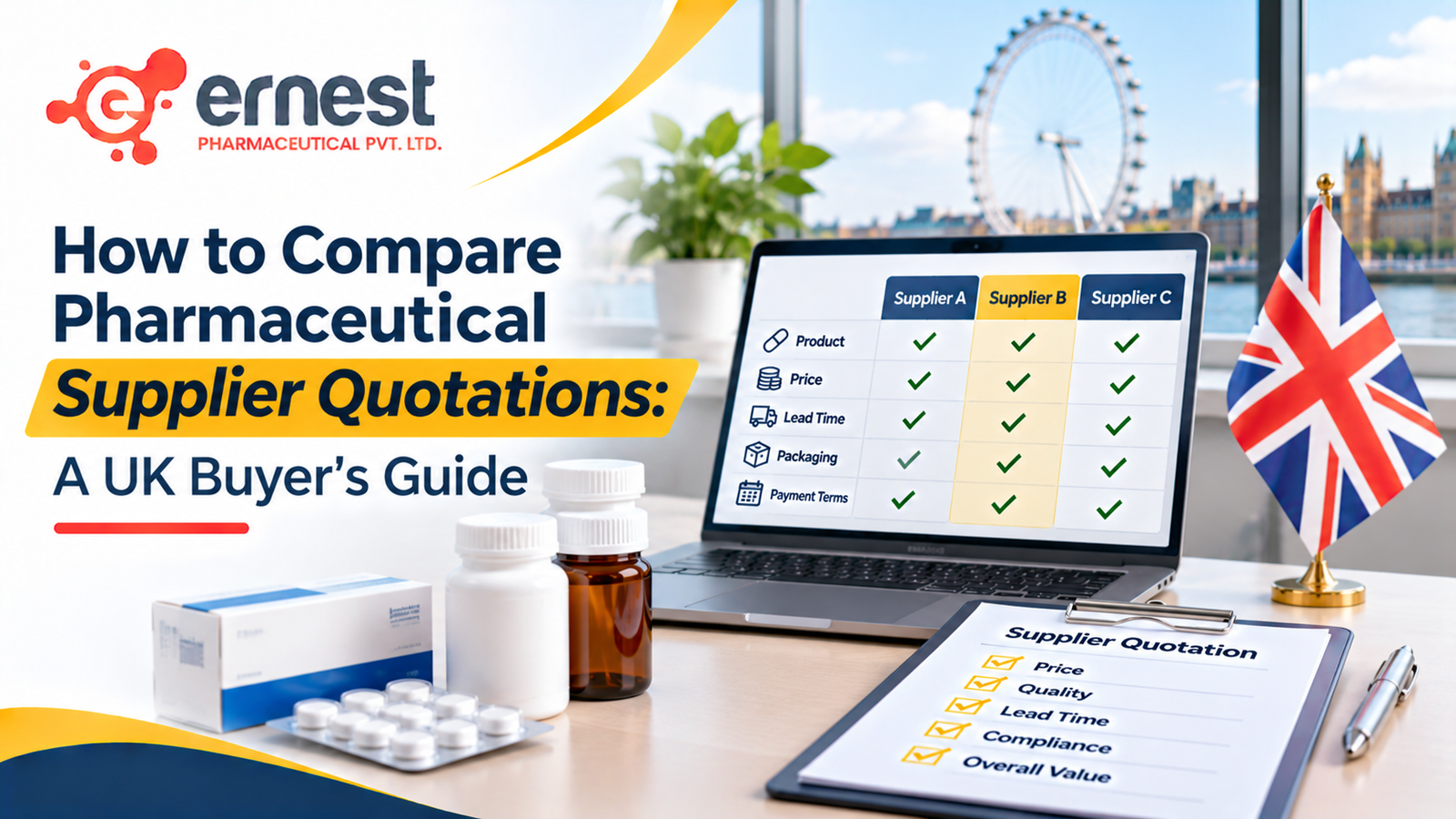
A structured pharma supplier quotation comparison helps buyers assess whether each quotation meets the same purchasing requirements. It also makes it easier to identify additional charges, evaluate supplier reliability and understand the total cost of procurement.
When sourcing medicines locally or internationally for UK buyers the aim should be to find a commercially appropriate supplier considering product quality, relevant regulatory requirements and continuity of supply.
This guide will show you how to compare pharma supplier quotations, what details to look out for and how to make a better procurement decision.
1. Begin with Same Product Requirements
Ensure that all suppliers have the same product specification before comparing quotations. If suppliers quote different strengths, dosage forms or pack configurations then their prices cannot be accurately compared.
A clear purchase request should have:
- Medicine name: Give the generic name and brand name, if applicable.
- Strength: Give the exact strength required, e.g. 250 mg, 500 mg or 1 g.
- Dosage form: Specify if the need is for tablets, capsules, injections, creams, syrups or other dosage form.
- Pack size: Indicate the number of tablets, capsules, vials or units per pack.
- Manufacturer preference: If you have a preference for a specific manufacturer or if alternatives are acceptable, please specify.
- Quantity to order: Specify the total quantity and preferred units of order.
- Shelf life requirement: Specify minimum remaining shelf life acceptable on delivery.
- Delivery destination : Check delivery address in UK and any special handling instructions.
- Documentation : Identify the documents required for the transaction, like – product, quality, batch or import related documents.
For example, you should not directly compare a quotation for 500 mg tablets with an offer for 250 mg tablets. Also, a price per strip is not the same as a price per box if the number of tablets in a box is not known.
Suppliers are responding to the same requirement when they are given accurate specifications, so comparing quotations from pharmaceutical suppliers is a meaningful exercise.
2. Confirm Supplier Identity and Business Credentials
A competitive quotation does not necessarily mean that a supplier is appropriate for pharmaceutical procurement. Buyers need to be aware of the supplier's legal identity, business role and ability to execute the contemplated transaction.
Relevant information should be requested from suppliers such as:
- Full registered company name and business address
- Official contact details and website.
- Pharmaceutical licenses or approvals applicable.
- Details of the business being a manufacturer, exporter, wholesaler, distributor or intermediary.
- Information regarding the proposed supply route.
- Any third-party storage or logistics providers involved including details.
Wholesale distribution in the UK The regulatory position will vary according to the supplier’s role and the nature of the transaction. The MHRA gives guidance on Good Distribution Practice (GDP), licensing and the sourcing of medicines. Buyers should check the authorizations relevant to their specific supply relationship rather than rely on the supplier’s business claims.
To evaluate applicable requirements read the official MHRA guidance on Good Manufacturing Practice and Good Distribution Practice.
For overseas purchases check the proposed import route and the obligations of the UK purchaser. The applicable requirements may vary depending on the product, country of origin and intended supply route.
It is useful to start by considering how UK wholesalers can assess international pharmaceutical suppliers, especially in terms of evaluating overseas offers.
3. Compare Product & Manufacturer Info
The same generic medicine may be made by different companies. But buyers should not treat two offers as identical simply because they share an active ingredient.
Refer to the product information included with each quote.
Some important points:
- Manufacturer’s name, place of manufacture.
- Common or trade name.
- Potency and active ingredient.
- Dosage form and route of administration, if relevant.
- Product presentation and packaging setup.
- Product specification and labeling information.
- Information on the status of the product including marketing authorization or other relevant information.
- Batch availability where allocated or confirmed.
If the supplier suggests an alternative brand or manufacturer, ask that the details be clearly identified in the quotation. Never take an alternative to be an exact match without checking the relevant product requirements.
Product information should also be consistent between the quotation, product specification, purchase order and supporting documents.
Refer to the UK pharmaceutical product specifications checklist for further guidance. It lists the product information that needs to be verified by procurement teams before placing an order.
4. Quality Documentation and Traceability Review
Documentation is an important part of pharmaceutical purchasing. A quotation may offer an attractive price but buyers should ascertain what documents are available and whether they can be provided at the appropriate stage of the transaction.
Buyers may need to request, depending on the product, supplier, country of origin and applicable requirements:
- Product specifications.
- Certificate of Analysis (CoA) if necessary.
- Lot or batch number information.
- Manufacture and expiry dates.
- Manufacturing quality documentation, applicable.
- Product labeling and packaging information.
- Storage and transport conditions.
- Any applicable regulatory or import paperwork.
Where batch specific documentation is required, the Certificate of Analysis should relate to the actual batch being supplied. Buyers should ensure that product names, strengths, batch references and other relevant details are consistent across the documents.
It is also useful to confirm when documents will be given. Some information may be available prior to purchase order, batch specific information may only be available once stock has been allocated.
Do not assume that a supplier’s statement that documents are available is enough. Ask what records will be delivered, who will deliver them and if they are appropriate for the buyer’s requirements.
To learn more about the checks that should be performed during procurement, read Pharmaceutical Procurement: Quality Checks and Cost Control.
5. Price per unit and total value of order
One of the first things buyers notice when looking through quotations is the unit price. But the quoted price must be seen in relation to the quantity and the unit of measurement.
Verify whether the supplier has provided a price for:
- Tablet/capsule
- Blister or strip.
- Pack or box.
- Vial or ampoule
- Unit of product, bottle or other.
- Bulk or carton shipment.
Also confirm the total quantity covered by the quotation and if the quoted amount covers all the requested products.
For instance Supplier A can sell a box at a lower price but the box could have less units than Supplier B's box. So, just comparing on the box price would give an inaccurate result.
Kindly review the following commercial details:
- Quoted in unit price.
- The total order value.
- Currency of quotation.
- Minimum Order Quantity (MOQ)
- Discounts by quantity.
- Price for quantity.
- Any extra fees.
- Validity Period of the Quotation
Buyers should also check to see if discounts are contingent on buying more than they need at the moment. If it results in excess inventory or a higher chance of losses due to expiry, lowering the unit price may not be advantageous.
6. Assess Total Cost to Land
When purchasing international pharmaceuticals the quoted price for the goods might not be the final cost of having the goods delivered to the UK.
Factors influencing medicine procurement costs UK buyers should factor in transportation, insurance, customs-related charges, handling and any relevant taxes or duties. Actual costs will vary by transaction, route, product and agreed commercial terms.
Here are some possible cost items:
- Product cost: Cost of the medicines.
- Freight Charges: Charges for transportation from the supplier to the agreed destination.
- Insurance: Associated costs of insurance of shipment.
- Customs and import duties: Duties, taxes and other charges as applicable.
- Handling fees: Charges for processing or handling the shipment.
- Temperature-controlled logistics: Extra costs where the product requires temperature-controlled storage or transportation.
- Customs clearance: Fees for services related to the clearance of the shipment.
- Other transaction costs: Other charges specified in the commercial agreement.
You should also check the agreed Incoterms as these establish important responsibilities between buyer and seller, including aspects of delivery, costs and risk transfer.
Ask suppliers to explain what charges are included in the quotation and what will be charged separately. If a cost cannot be confirmed at the quote stage, do not treat it as a fixed cost but record it as an estimate or to be confirmed.
Looking at the total landed cost provides a more realistic basis for evaluating competing offers than simply looking at product price.
7. Check for Minimum Order Quantity and Life Span
The minimum order quantity and remaining shelf life can have a direct impact on procurement decisions.
A supplier might offer a lower price per unit if you buy in bulk, but buying more stock than you need will lead to extra storage costs and the risk of medicines expiring before they are used or distributed.
Before you accept an offer, make sure:
- Supplier minimum order quantity.
- Ability to add mixed products to one order.
- Whether the quoted quantity is available at the moment.
- Remaining expected shelf life at delivery.
- Whether the supplier can confirm batch details prior to dispatch.
- Possibility of partial deliveries.
- Whether the number proposed matches the demand expected.
Shelf life requirements should be agreed prior to purchase confirmation. Buyers should not assume that the general shelf life information for a product is indicative of the shelf life of the particular stock on offer.
If a slightly higher price quotation provides a quantity and shelf life that better fits the buyer’s inventory requirements, it may be more commercially appropriate.
8. Check Delivery Times and Logistics Arrangements
Another important aspect of a supplier quote is the delivery commitments. The offer of low cost may be less suitable if the delivery period does not correspond to the operational needs of the buyer.
Please see the information below:
- Estimated delivery date.
- Estimated time of arrival.
- Whether the goods are already available or have to be bought or made.
- Shipping method & route.
- Freight arrangements responsibility.
- Availability of shipment tracking.
- Packaging and handling procedures.
- Temperature checks, if necessary.
- Procedure for reporting delayed and damaged shipments.
If you ship temperature sensitive products, ask how the shipping conditions will be maintained during transit and what documentation they can provide to support.
Also, decide who will provide updates about shipment and how will they take care of unexpected delays. Clear responsibilities minimize confusion between the buyer, supplier and logistics provider.
You should also consider the delivery reliability as well as the price, because a delayed delivery can impact the stock availability, inventory planning and business operations.
9. Check Quotation Validity and Payment Terms
Payment terms can influence the overall commercial viability of a supplier. Quotes with similar product prices may have different payment requirements.
Kindly confirm the following:
- Payment terms in advance.
- Payment terms: Balance
- Payment methods accepted.
- Currency of payments.
- Where applicable - bank charges.
- Payment terms, where available.
- Dates of payment.
- “Terms of order confirmation.
- Validity of quotation and terms of price revision.
Always check the time the quotation is valid for. Prices of pharmaceuticals and availability of stock are subject to change and an expired quotation cannot be considered as a current offer unless confirmed in writing.
Before you send money, double-check the supplier’s official payment details using a known channel of communication. “Please independently verify any unexpected change to bank information.
10. Use a Standard Supplier Comparison Checklist
With a standard comparison checklist, procurement teams can evaluate each quote by the same criteria. It also provides a written record of the selection of a supplier.
Review for each supplier:
- Product name, strength and dosage form.
- Introduction of manufacturer and product.
- Total quantity and pack size.
- Unit price and total order amount.
- Min. order quantity.
- Shelf life remaining.
- Availability of documentation.
- Supplier credentials and applicable permissions.
- The delivery schedule and logistics arrangements.
- Freight, insurance and other applicable duties.
- Quotation validity & payment terms.
- Communication and support after the sale.
Once these details have been reviewed, classify each quotation according to whether it meets the product requirements, commercial expectations and relevant purchasing conditions.
If information is missing, request clarification before making the final decision. Do not assume that a charge, document or delivery condition not specified is included.
11. Common Mistakes to Avoid When Comparing Quotes in Pharma
Even the most experienced procurement teams can miss critical details in reviewing multiple offers. The following errors can render a supplier comparison unreliable:
- Lowest Unit Price: Lower price may exclude freight, insurance or other charges:
- Price comparisons are not valid if there are differences in strength, formulation, manufacturer or pack size. Compare different product specifications
- Shelf life not remaining: buyer's inventory requirements may not be met by perishable inventory.
- Ignoring minimum order quantities: Large MOQs can increase stockholding costs.
- Accepting vague documentation commitments: Buyers need to make sure what records will be available and when.
- No supplier qualification. Commercial terms do not replace proper supplier and supply chain qualification.
- Not acknowledging delivery duties: Unclear logistics arrangements can lead to unforeseen costs and delays.
- Expired quotations: Prices and stock availability should be reconfirmed before ordering.
Avoiding these mistakes makes supplier selection more predictable and enables buyers to recognize concerns before they become costly procurement difficulties.
Conclusion
To find out how to compare pharmaceutical supplier quotes you need to look beyond just the lowest price on offer. UK buyers should cross-check matching product specifications, manufacturer details, supplier credentials, quality documentation, remaining shelf life, minimum order quantities, logistics arrangements and payment terms.
A full pharma supplier quotation comparison should also include the total landed cost, especially if sourcing medicines internationally. That gives procurement teams a better understanding of the financial and operational impact of each offer.
When product requirements are consistent and supplier comparison processes are structured, wholesalers, distributors, pharmacies and healthcare procurement teams can make more informed purchasing decisions.
Ernest Pharmaceuticals is a source of information on pharmaceutical products and business inquiries for buyers sourcing their medicine requirements. Visit the Ernest Pharmaceuticals website to see company information and products.
Frequently Asked Questions (FAQ)
1. How do you compare quotes of pharmaceutical suppliers?
product specification manufacturer pack size quantity unit price minimum order quantity remaining shelf life documentation delivery terms payment terms Add applicable freight, insurance, customs and other charges for international orders.
2. Why can't buyers pick a pharmaceutical supplier based on price?
Lowest price does not include all shipping or import charges. It may also mean different product specifications, a shorter shelf life remaining, higher minimum order quantities, or less suitable delivery arrangements. Buyers should look at the entire offer before making a decision.
3. What should be included in a pharmaceutical supplier quotation?
A useful quote should include medicine, strength, dosage form, manufacturer, pack size, quantity, unit price, total amount, currency, MOQ, delivery time, payment terms and validity period. Also, make clear the relevant documentation and extra charges.
4. What is total landed cost in pharma procurement?
The total landed cost is the cost of getting the goods to the agreed destination and receiving them. Depending on the transaction, it may include the price of the product, freight, insurance, customs charges, applicable taxes, handling and clearance expenses.
5. Why is the remaining shelf life important when comparing offers from suppliers?
The remaining shelf life is the time left for the buyer to store, distribute or use the medicine before its expiry. Shorter shelf life increases inventory risk, especially with uncertain demand or longer-than-expected distribution times.
6. What paperwork should UK buyers ask for from pharmaceutical suppliers?
Buyers may request product specifications, applicable quality records, batch details, a Certificate of Analysis, manufacturing and expiry details, labeling information, and any relevant regulatory or import documents, depending on the product and transaction. Confirm real requirements for the suggested supply path.
7. When considering international pharmaceutical suppliers, UK buyers should consider:
Buyers should check the legal identity of the supplier, their role in business and any relevant authorizations. They should also consider product status, quality documentation, supply chain arrangements, logistics capabilities and the requirements that apply to importing and distributing the medicine in the UK.
8. How frequently do you need to review your pharmaceutical supplier quotes?
Quotations should be rechecked when a new purchase is planned or when there is a change in important details, e.g. availability, price, quantity, delivery route or payment conditions. Buyers also should reconfirm expired quotations before placing an order.