Pharmaceutical Certificate of Analysis: Buyer Checklist
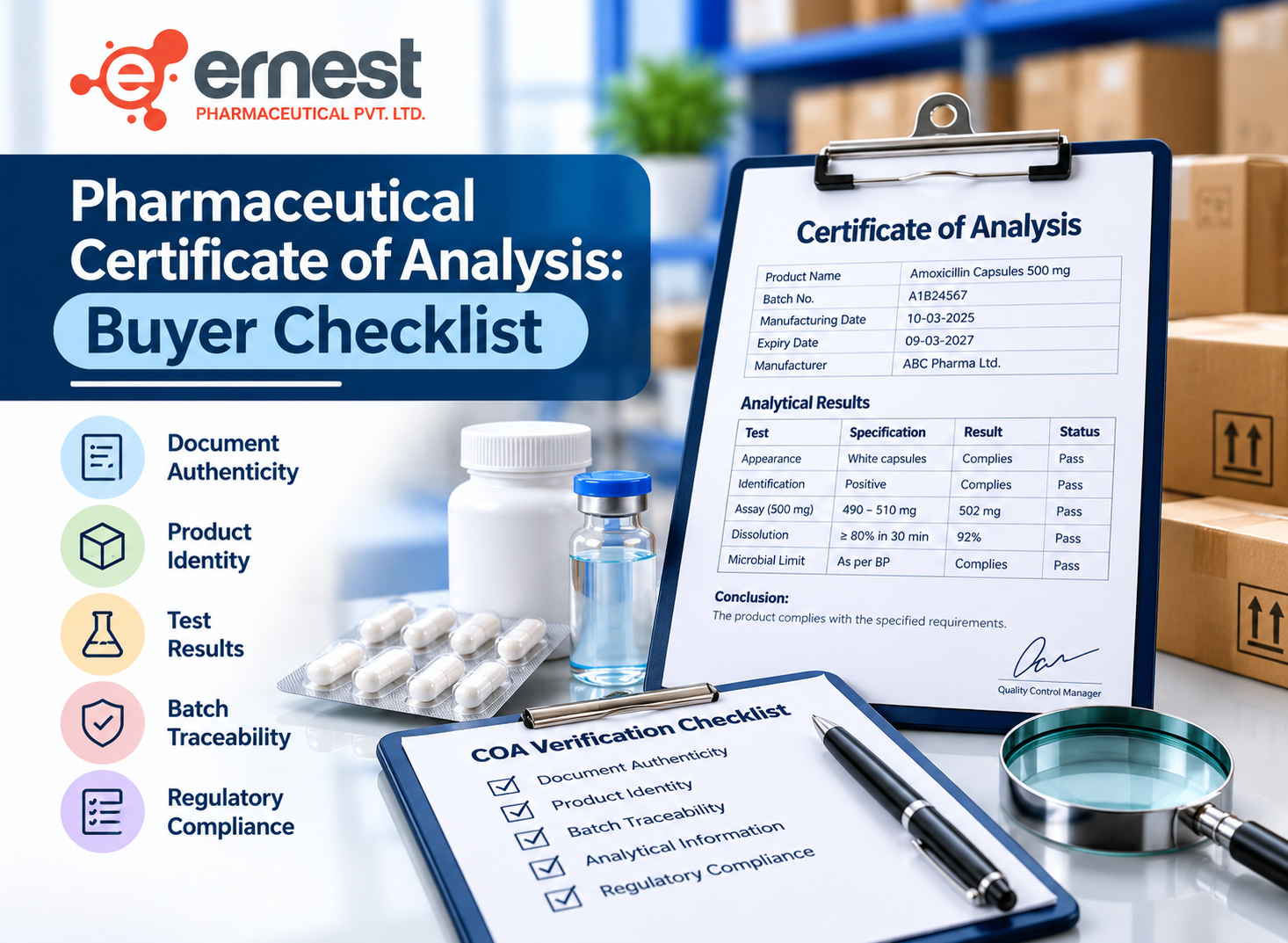
Pharmaceutical Certificate of Analysis (COA): A Practical Buyer Checklist
Buying pharmaceutical products for international distribution involves more than comparing prices, quantities, and delivery schedules. Buyers also need to review documents that identify the product, its manufacturer, and the quality testing for the supplied batch. One important document in this process is the Pharmaceutical Certificate of Analysis (COA).
A COA provides laboratory test information for an identified pharmaceutical material or product. It helps buyers and quality teams understand what was tested, which specifications were applied, and whether the reported results met the relevant acceptance criteria. However, simply receiving a COA does not mean that every detail has been verified. This guide explains how international pharmaceutical buyers can review a Certificate of Analysis, identify documentation concerns, and prepare a practical checklist before placing or accepting an order.
What Is a Pharmaceutical Certificate of Analysis?
A Pharmaceutical Certificate of Analysis is a laboratory document that reports analytical findings for an identified sample or batch of a pharmaceutical material or finished medicine. The document generally includes product identification, batch information, testing specifications, analytical results, and authorization details. A Drug Certificate of Analysis may relate to an active pharmaceutical ingredient, another starting material, or a finished drug product. The relevant tests and reporting requirements depend on what has been examined. For example, a COA for an active pharmaceutical ingredient may focus on identity, assay, impurities, and other material-specific characteristics. A finished tablet may require additional testing relevant to its dosage form. The World Health Organization (WHO) provides a model Certificate of Analysis for starting materials and finished pharmaceutical products. This model illustrates the information that may appear in a properly structured certificate.
Why Is a Certificate of Analysis Important for International Buyers?
International pharmaceutical procurement frequently involves several organizations, including manufacturers, suppliers, exporters, importers, distributors, and testing laboratories. Clear documentation enables these parties to identify the supplied goods and review relevant quality information.
Supports Batch Traceability
A batch number connects the reported analytical findings with a particular batch of material or finished product. Buyers can compare this number with product packaging, invoices, packing lists, and other available records.
Helps Review Reported Quality Results
A COA identifies relevant analytical tests and their reported outcomes. Qualified reviewers can compare those results with the applicable specifications to determine whether the document supports the expected quality requirements.
Supports Supplier Qualification
A COA can contribute to supplier evaluation by providing information about the product, testing organization, and quality documentation. Buyers can also review pharmaceutical procurement quality checks when evaluating supplier documentation. Nevertheless, supplier qualification should also consider appropriate licences, manufacturing arrangements, regulatory status, and other relevant evidence.
Helps Identify Documentation Discrepancies
Differences between the COA, purchase order, product packaging, and shipment records may indicate a documentation issue requiring clarification. Identifying such differences before shipment can help avoid unnecessary delays in the procurement review process.
Pharmaceutical COA Verification Checklist for Buyers
A practical COA verification checklist should focus on document authenticity, product identity, batch traceability, and analytical information.
The following checks can help buyers organize their initial review.
1. Verify the Product Name, Strength, and Dosage Form
Start by checking the product identification details. Look for the generic or active ingredient name, brand name where relevant, dosage form, and strength. Compare these details with the purchase order and product specifications.
For example, a certificate for a 250 mg tablet should not be assumed to represent a 500 mg tablet or an injectable product containing the same ingredient. If the product description is incomplete or inconsistent, ask the supplier for clarification.
2. Match the Batch or Lot Number
The batch number is one of the most important details in pharmaceutical COA verification. Compare the batch number recorded on the certificate with the batch number shown on the supplied goods and related documentation. Check for differences in letters, numbers, or formatting that may affect identification. A certificate issued for one batch should not automatically be accepted as analytical evidence for another batch. Where an order contains multiple batches, buyers should establish which certificate and quality records correspond to each batch.
3. Check the Manufacturer and Laboratory Details
Review the name and address of the organization responsible for issuing the COA. Where relevant, identify the original manufacturer and the laboratory that performed the testing. If the certificate was provided through a trader or distributor, clarify the relationship between the supplier, manufacturer, and issuing laboratory. Buyers should not assume that a certificate is authentic simply because it includes a company name or logo. When necessary, document authenticity should be confirmed through independently verified contact details. The WHO Good Practices for Pharmaceutical Quality Control Laboratories guide laboratory quality systems, documentation, and reporting of analytical results.
4. Review Manufacturing, Expiry, and Retest Dates
Check the dates recorded on the certificate.
Depending on the product, these may include:
- Manufacturing date
- Sample receipt date
- Testing completion date
- Expiry date
- Retest date
An expiry date and a retest date are not interchangeable. A retest date may be applicable to certain pharmaceutical starting materials, while finished medicines generally carry expiry information according to applicable requirements. Compare the available dates with product labels and supporting records. Unexplained inconsistencies should be referred to the supplier or qualified quality personnel.
5. Examine the Applicable Specifications
A Certificate of Analysis should identify the specifications used to evaluate the tested material or product. Depending on the pharmaceutical product, these may refer to a recognized pharmacopoeial standard or an approved product-specific specification. The applicable standard should be relevant to the product, dosage form, and intended market. For example, a reference to a pharmacopoeia does not by itself establish that every applicable requirement has been satisfied. Buyers should confirm that the specification and testing approach are appropriate for the particular product.
6. Review the Laboratory Test Results
Analytical test results are central to a Medicine Certificate of Analysis.
Depending on the product, relevant tests may include:
- Identification of the active ingredient
- Assay or active ingredient content
- Related substances and impurities
- Dissolution or disintegration
- Uniformity of dosage units
- Water content
- Microbiological quality
- Sterility or bacterial endotoxins, where applicable
Not all tests apply to every product. For instance, sterile injectable medicines require different quality assessments from conventional oral tablets. The reviewer should examine the reported results alongside the acceptance criteria and test references. A general statement such as "Pass" may be appropriate for certain qualitative tests, but it should not automatically replace quantitative data where such data are required. Technical interpretation should be performed by appropriately qualified personnel. For products subject to U.S. requirements, the FDA's current good manufacturing practice guidance provides additional information about manufacturing controls, testing, and quality assurance.
7. Check the COA Authorization
A COA should contain appropriate evidence that the analytical information has been reviewed and authorized. Depending on the laboratory's quality system, this may involve a signature, authorized electronic approval, or another controlled method. Review the document identification number, issue date, revision details where applicable, and authorization information. If the document appears incomplete or altered, request confirmation from the issuing organization.
8. Compare the COA With Procurement and Shipment Records
International buyers should consider the COA alongside other transaction documents.
Relevant records may include:
- Purchase order
- Commercial invoice
- Packing list
- Product labels
- Manufacturer documentation
- Batch-related quality records
Compare the product name, strength, batch number, and other relevant identifiers across these records. The documents do not necessarily contain identical information, but overlapping details should be consistent. A discrepancy should be investigated rather than corrected informally without supporting evidence. International buyers should also understand how pharmaceutical packaging and supply chain processes support product identification, batch traceability, and shipment documentation.
Common Warning Signs in a Pharmaceutical COA
A document may require further review when important information is missing, inconsistent, or difficult to verify.
Batch Number Does Not Match
If the certificate identifies a different batch from the goods offered, the buyer should request the correct documentation or an explanation supported by appropriate records.
Missing Analytical Information
A COA that omits expected tests, specifications, or results may not provide enough information for a proper technical assessment. The applicable requirements should be determined according to the product and relevant quality standards.
Unclear Issuing Organization
A certificate without identifiable laboratory or manufacturer information can make authenticity checks difficult. Buyers should request additional details when the issuing organization cannot be established.
Inconsistent Dates or Product Details
Differences in manufacturing dates, expiry information, strength, or dosage form may indicate documentation errors. These differences should be resolved before the certificate is relied upon.
Unexplained Changes to the Document
Altered batch numbers, inconsistent formatting, or missing approval details may justify additional investigation. Such signs do not automatically prove that a document is fraudulent, but they should not be ignored.
Certificate of Analysis vs GMP Certificate vs Certificate of Pharmaceutical Product
International pharmaceutical buyers may receive several quality and regulatory documents. Understanding their different purposes helps avoid confusion.
Certificate of Analysis (COA)
A COA reports analytical findings for an identified sample or batch and the specifications used to assess those findings.
Good Manufacturing Practice (GMP) Certificate
A GMP certificate provides information about a manufacturing site's compliance status within the scope of the relevant inspection or certification process. It does not replace batch-specific analytical information.
Certificate of Pharmaceutical Product (CPP)
A CPP is associated with the WHO Certification Scheme for pharmaceutical products moving in international commerce. It communicates specified regulatory information concerning a pharmaceutical product and relevant parties in the exporting country. It is not equivalent to a COA. The documents required for a transaction depend on the product, importing country, regulatory pathway, and procurement arrangements.
What Should Buyers Do if a COA Contains a Discrepancy?
A documentation discrepancy should be handled through a controlled clarification process. First, identify the exact information that appears incorrect or inconsistent. Next, compare the certificate with the purchase order, product packaging, and supporting documents. Contact the supplier and request an explanation, corrected controlled document, or additional evidence as appropriate. If the discrepancy concerns analytical results, product identity, or other material quality information, refer it to qualified quality personnel. Buyers should avoid changing a certificate themselves or accepting an unexplained correction. Where necessary, keep the affected goods or procurement decision on hold until the issue has been assessed under the applicable quality procedures.
Questions to Ask Suppliers Before Confirming an Order
Before accepting pharmaceutical quality documentation, international buyers can ask the supplier:
1. Is the COA available for the exact batch being supplied?
2. Who manufactured the product and who performed the testing?
3. Which specifications were used?
4. Can the batch details be matched with the product packaging?
5. Are all applicable analytical results included?
6. Can the certificate's authenticity be independently verified?
7. Are supporting quality and regulatory documents available?
8. Are additional documents required for the destination country?
These questions can help procurement teams organize their review and identify issues requiring technical clarification.
Frequently Asked Questions
1. What is the purpose of a Pharmaceutical Certificate of Analysis?
A Pharmaceutical Certificate of Analysis reports laboratory test findings for an identified sample or batch. It helps qualified reviewers assess the reported results against the relevant specifications.
2. How can buyers verify a pharmaceutical COA?
Buyers can compare product and batch information, review the issuing laboratory, examine specifications and results, and request independent confirmation of authenticity where necessary.
3. Is a COA the same as a GMP certificate?
No. A COA reports analytical findings, while a GMP certificate concerns manufacturing compliance within the scope of the relevant certification or inspection.
4. Can one COA be used for multiple batches?
A batch-specific COA should not automatically be treated as evidence for another batch. Buyers should establish which analytical records correspond to each batch supplied.
5. What information should a drug Certificate of Analysis contain?
Relevant information may include product identification, batch number, manufacturer and laboratory details, specifications, test results, applicable dates, and authorization.
6. Does a COA confirm that a pharmaceutical product is approved for import?
No. A COA does not replace marketing authorization, import permissions, or other regulatory documents required by the destination country.
7. What should buyers do if the COA does not match the shipment documents?
They should request clarification and supporting evidence from the supplier. Material discrepancies should be reviewed by qualified personnel before the documentation is accepted.
Conclusion
A Pharmaceutical Certificate of Analysis is an important part of pharmaceutical quality documentation, but its usefulness depends on careful review.
For international importers, wholesalers, distributors, and procurement teams, checking product identity, batch numbers, laboratory details, specifications, test results, and authorization can help identify documentation concerns before an order progresses.
A practical COA verification checklist also encourages buyers to compare analytical records with procurement and shipment documents rather than reviewing each document in isolation.
Ultimately, a COA should be considered alongside supplier qualification, relevant manufacturing records, regulatory requirements, and professional quality assessment.
A well-organized documentation review supports more informed pharmaceutical procurement decisions and better batch traceability across the supply chain.