Pharmaceutical Supplier Quality Agreement: Key Clauses
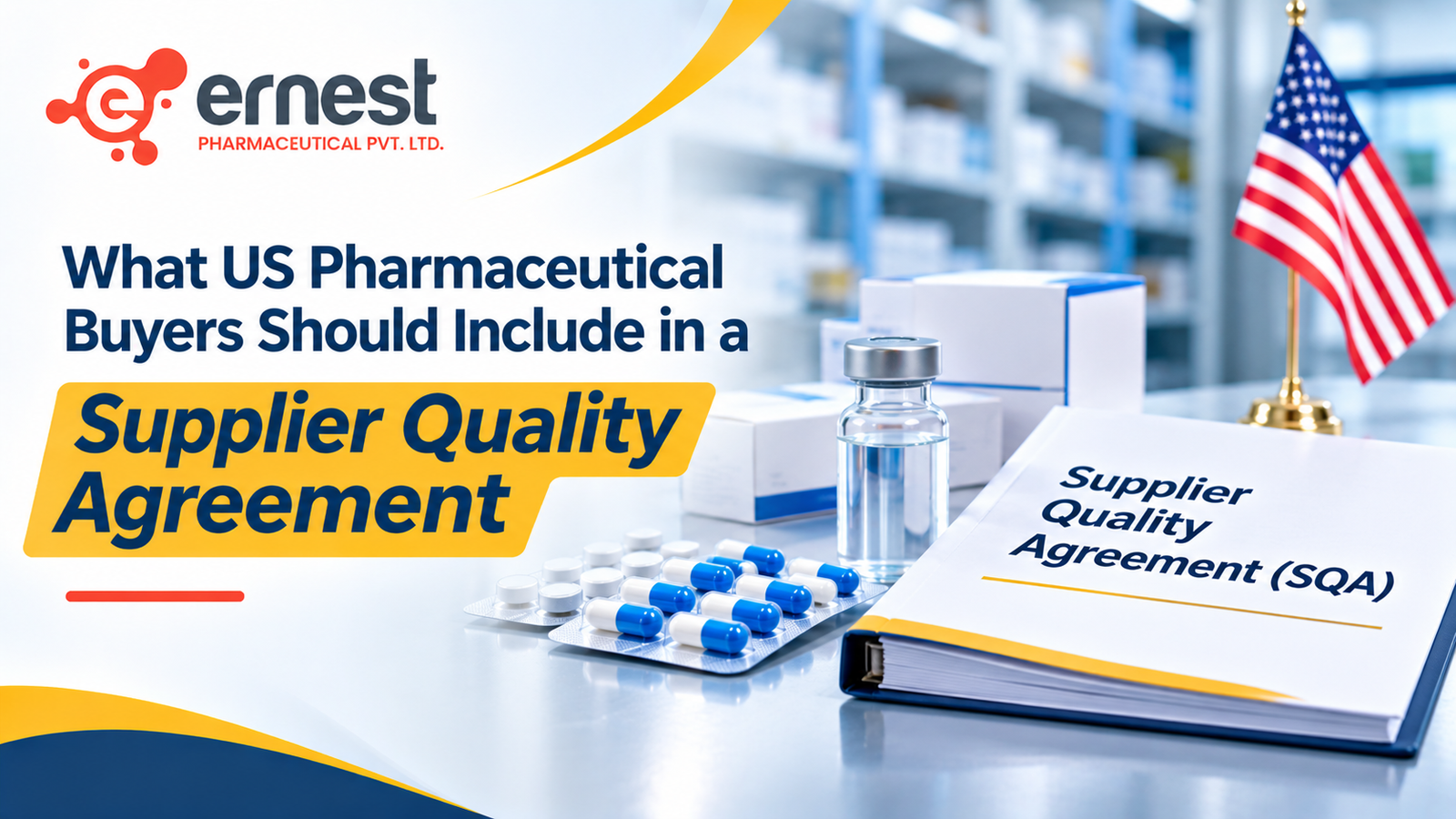
What US Pharmaceutical Buyers Should Include in a Supplier Quality Agreement
Introduction
Pharmaceutical procurement is not merely about selecting a manufacturer, comparing quotations and arranging for product delivery. Clearly defined quality responsibilities are also important for US pharmaceutical buyers who work with overseas manufacturers, exporters, contract facilities and distributors.
A pharmaceutical supplier quality agreement is a written document describing how the parties will conduct quality-related activities, documentation, communication and responsibilities that are applicable during the business relationship. It helps to reduce misunderstandings concerning product specifications, manufacturing controls, testing, deviations, complaints and other quality matters.
Without well-documented expectations, buyers and suppliers can experience delays when managing quality discrepancies, investigating complaints, reviewing batch records or communicating significant product changes.
A good agreement gives both parties a mutual reference point for quality related responsibilities . It also provides supplier oversight and more structured pharmaceutical sourcing.
This guide outlines the key clauses US pharmaceutical buyers ought to give priority to when creating or evaluating a supplier quality agreement, including practical responsibilities, documentation requirements, and communication practices.
What is a Supplier Quality Agreement in the Pharma Industry?
A pharmaceutical supplier quality agreement is a written agreement that describes the quality-related responsibilities and expectations of organizations involved in the supply, manufacture, testing, packaging, storage or distribution of pharmaceutical products.
The agreement outlines the party responsible for specific quality activities and the ways in which information is to be communicated and recorded.
For example, a contract between a pharmaceutical manufacturer and a foreign buyer may include:
- The product specification and the quality requirements that apply.
- Production and quality control responsibilities.
- Certificates of Analysis and batch documentation.
- Reporting and investigation of deviations.
- Product complaints and corrective action.
- Notification and approval procedures.
- Storage, transport and traceability requirements.
- Record keeping and audit arrangements.
The exact scope depends on the product, business relationship, activities performed by each party and the applicable regulatory requirements.
FDA’s guidance for Contract Manufacturing Arrangements for Drugs: Quality Agreements describes how parties to contract manufacturing may document the parties’ respective manufacturing activities and CGMP responsibilities.
Buyers should note however that this guidance applies to contract manufacturing arrangements only. Thus, it is not automatically to be read as requiring identical terms for every ordinary purchasing or distribution relationship.
Why Buyers of US Pharmaceuticals Need a Supplier Quality Agreement
A medicine might be passed through multiple organizations before it reaches its destination of US pharmaceutical buyers. The responsibilities may vary for manufacturers, exporters, testing laboratories, packaging facilities, logistics providers and importers.
A quality agreement sets out the expectations of the parties involved.
1. Defines supplier quality responsibilities-
One of the main purposes of an agreement is to remove any doubt as to who is responsible for performing specific quality-related activities.
For example:
- The manufacturer may be responsible for manufacturing controls and applicable batch documentation.
- The testing laboratory may conduct agreed analytical testing.
- The supplier or exporter may be responsible for providing the agreed product and shipment documents.
- Buyer may have responsibility to review supplied documents and communicate any discrepancies identified.
- Designated quality units may be authorized to make quality decisions within their respective organizations.
Responsibilities should correspond to the real activities and legal liabilities of each organization.
2. Enhances Documentation and Traceability
Accurate product and batch information is required for pharmaceutical procurement.
A quality agreement can set out what documents will be provided, when they will be shared and how disagreements will be handled.
It helps buyers investigate product or documentation issues and allows for more structured record keeping.
3. Establishes Procedures for Handling Complaints
Product complaints might include packaging defects, incorrect labeling, damaged shipments, documentation discrepancies or suspected quality issues.
The agreement should explain how complaints are reported, acknowledged, investigated and communicated between the parties.
4. Supports Organizational Change Management
Changes in manufacturing processes, specifications, testing methods, packaging or manufacturing locations may affect product quality or regulatory obligations.
And a set process for notification helps buyers understand what changes should be communicated and if further review is necessary.
5. Enhances Supplier Oversight
A quality agreement is used as a reference to monitor supplier performance, review documentation and evaluate if agreed quality responsibilities are being met.
For a more thorough supplier assessment process, buyers can also refer to Ernest Pharmaceuticals' guide on how US distributors can evaluate pharmaceutical suppliers.
What Clauses to Include in a Pharmaceutical Supplier Quality Agreement
The following clauses can help US pharma buyers organize their quality expectations when drafting or reviewing an agreement.
1. Purpose and Scope of the Agreement
The object of the agreement and the products, facilities, services and activities to which it applies should be specified in the agreement.
Inclusion:
- Names and legal identities of the organizations participating.
- Products or types of products treated.
- Places of manufacture or supply, where applicable.
- Activities carried out by each party.
- Relevant quality standards and regulatory requirements.
- Effective date and duration of agreement.
The scope should be clear enough to provide insight into which products and activities are included.
2. Quality Responsibilities and Roles
One of the most important pieces of a pharmaceutical vendor contract.
The parties should clearly identify who is responsible for each relevant quality activity.
Depending on the arrangement, responsibilities might include:
- Process and manufacturing controls.
- Laboratory and sampling analysis.
- Product specifications
- Batch review and documentation.
- Quality approval and dispositioning.
- Packaging and labeling controls.
- Conditions of storage and transport.
- Investigate complaints.
- Managing deviation.
- Regulatory correspondence.
The agreement should identify the right quality contacts and decision-making responsibilities.
Importantly, a contractual arrangement may not be used to transfer or remove statutory or regulatory responsibilities that would otherwise remain with an organization under applicable law.
3. Product Specifications and Quality Requirements
The agreement should outline the product requirements expected of both parties.
These can include:
- Name and identification of product.
- dosage form and strength.
- Relevant specifications.
- Labeling and packaging requirements.
- Appropriate testing requirements.
- Conditions of storage.
- Requirements on batch identification and traceability.
Where specifications are held in separate controlled documents the agreement should describe the method of identification, approval and updating of such documents.
They should also agree a process for resolving differences between agreed specifications and supplied product information
4. Supplier Qualification and Right to Audit
Buyers should define an appropriate qualification process based on the supplier’s activities and related risks prior to entering into a supplier relationship.
“This agreement may include:
- Supplier qualification criteria.
- Information on any manufacturing sites involved.
- Use of GMP documentation.
- Evaluation of the quality system.
- Access and audit arrangements.
- Corrective actions subsequent to audit findings.
- Regular supplier performance review.
The parties shall agree upon the manner of requesting, scheduling, conducting and documenting audits.
Buyers should also determine the actual manufacturer when sourcing internationally and understand whether the contracting supplier is a manufacturer, exporter, distributor or intermediary.
5. Records and Documentation Management
It should be clear who is responsible for the documentation so that the necessary documentation is available when required.
Relevant documents may include, depending on the product and transaction:
- Technical information.
- CoA (Certificate of Analysis) for each batch.
- Batch manufacturing records or test records, where applicable.
- Information on the manufacturing site and suppliers.
- Relevant GMP documentation.
- Information on product packaging and labeling.
- Stability and storage information if applicable.
- Shipping and traceability records.
The agreement should outline document formats, responsible parties, submission timeframes and record-retention expectations.
To learn more about batch-specific quality documentation, check out the Certificate of Analysis in Pharmaceutical Procurement guide.
6. Deviation, Out of Specification and CAPA Management
A deviation is when an activity is not in accordance with a procedure or requirement. Definition: Out of Specification (OOS) Result A test result that does not meet an applicable specification.
The agreement should say how those issues are reported, investigated and resolved.
Main points:
- Who needs to be informed when a problem is identified.
- How fast the notification should be sent.
- Who's investigating.
- Sharing of evidence and records
- How the conclusions of the investigation are communicated.
- Registering and follow up of corrective and preventive actions (CAPA).
The agreement should also specify the escalation procedure for unresolved quality issues to the appropriate quality representatives.
7. Prior Notification and Change Control
Suppliers shall not change product or quality requirements agreed without following the established change control process.
The agreement should identify changes that require notification, evaluation, or approval before implementation.
Examples might include:
- Shifts in manufacturing locations.
- Modifications in production processes.
- Changes in raw materials or suppliers.
- -Changes to analytical procedures.
- Modifications in product specifications.
- Change in packaging or labeling.
- Modification of storage or handling conditions.
The agreement should also describe how changes are evaluated for potential impact on product quality and regulatory compliance.
8. Recalls, Communications and Product Complaints
The supplier quality agreement should include a clear description of the process for product complaints and possible quality incidents.
It should define:.
- Ways to submit a complaint.
- Need complaint information.
- Responsibility for recognition and investigation.
- Timelines for communication.
- Procedures for escalation.
- Requirements for recordkeeping.
- Collaboration in product-recall or product-retrieval activities where applicable.
Both parties shall identify their respective quality contacts and ensure that important quality information is passed on to the appropriate personnel without unnecessary delay.
9. Storage, Distribution and Transport
Improper storage, handling and transportation conditions can affect the product quality.
The agreement should specify the responsibilities of each party for maintaining the necessary conditions for the performance of the activities covered by the arrangement.
Consider including:
- Relevant requirements for storage temperatures.
- Handling and packing instructions.
- Transport conditions.
- Where required, monitoring of temperature.
- Documents of shipment.
- Procedures for reporting damaged goods or goods exposed to temperature fluctuations.
- Product distribution and traceability records.
The roles and responsibilities of the manufacturer, exporter, logistics provider, distributor and other relevant parties should be clearly defined.
10. Third Party Activities and Subcontracting
If a supplier uses another organization to do manufacturing, testing, packaging, storage or other quality-related activities the arrangement should be addressed in the agreement.
The buyer must establish:
- If subcontracting is permitted.
- Activities that can be outsourced.
- Qualification of subcontractors.
- If prior notification or approval is required.
- How quality responsibilities are communicated.
- How audit and access to relevant records is maintained.
Where the agreement provides for assessment or approval a supplier should not be allowed to make unapproved changes to important outsourced arrangements.
11. Review of Agreement, Changes and Dispute Resolution
A quality agreement should be applicable to the whole business relationship.
The parties should agree how the agreement will be reviewed and updated when there are changes to products, facilities, responsibilities or applicable requirements.
The present invention relates to an improved method and apparatus for producing and dispensing a liquid product, and more particularly to an improved method and apparatus for producing and dispensing a liquid product such as a beverage, a food product or a cosmetic product.
- Date of coming into force and frequency of review.
- Procedures of amendment.
- authorized representatives for consent.
- Settlement of disputes concerning quality.
- Procedures for dealing with obsolete versions of agreements.
- Duties on termination or transition.
Disagreement relating to quality should have a defined escalation process with appropriate representative from each organization.
Practical Quality Agreement Checklist for Pharma Buyers
Here’s a checklist US buyers can use before approving a pharmaceutical supplier quality agreement:
- Scope: Are the products, facilities and activities clearly defined?
- Responsibilities: Are quality responsibilities assigned to the right people?
- Specifications: Are the product and quality requirements specified?
- Supplier qualification Are there defined arrangements for the assessment and audit of suppliers?
- Documentation: Are the required batch records and quality records identified?
- Deviations: Is there a procedure for investigation and reporting?
- CAPA: Are the responsibilities for corrective and preventive action clear?
- Change control: Is there an agreed process for notification and review of significant changes?
- Complaints: Is there documented complaint management and escalation procedures?
- Recalls: Are duties of cooperation and communication defined?
- Storage and shipment: Are handling requirements allocated as appropriate?
- Subcontracting: Are third parties’ activities controlled?
- Communication: Are there quality contacts and notification channels?
- Review: Is there a procedure in place for amending the agreement?
This checklist should be tailored to the actual supplier relationship, product risks and applicable regulatory requirements. It does not replace a legal or regulatory review.
Regulatory Aspects of Quality Agreements and FDA Guidance
Before US pharmaceutical buyers sign off on an agreement, they need to know the regulatory context.
On November 2016, the FDA published its guidance, Contract Manufacturing Arrangements for Drugs: Quality Agreements , which explains how owners and contract manufacturing facilities can document their respective CGMP activities and responsibilities.
The guidance identifies key areas including:
- Operations, manufacturing.
- Responsibilities of the quality unit.
- Change management.
- Communications.
- Resolution of disagreements.
- Review and revision of contracts.
The FDA also states that quality agreements cannot be used to delegate statutory or regulatory responsibilities for compliance with CGMP.
The FDA's Q10 Pharmaceutical Quality System guidance also offers a globally harmonized framework for pharmaceutical quality management.
The scope of these references should be kept in mind. The specific regulatory requirements vary by product, activity, organizations involved and US requirements that apply.
How Ernest Pharmaceuticals Cultivates Relationships in the Pharma Industry
Effective pharmaceutical sourcing requires straightforward communication, proper documentation and an understanding of product and supplier requirements.
Ernest Pharmaceuticals - Pharmaceutical Business & Product Portfolio Information For Domestic & International Business Inquiries.
Buyers may review Ernest Pharmaceuticals products to explore the product categories available and identify any potential sourcing requirements.
To learn more about the company’s history and business activities, please visit the Ernest Pharmaceuticals About Us page.
Buyers should discuss product specifications, manufacturer details, applicable quality documents, batch information, availability and regulatory requirements before entering into a supplier relationship.
The quality agreement should then reflect the responsibilities and procedures that are applicable to the actual business arrangement.
Final Thoughts
A pharmaceutical supplier quality agreement is a key document to establish clear quality expectations between pharmaceutical buyers, manufacturers, exporters and other supply chain partners.
The agreement for US pharmaceutical buyers should cover responsibilities, product specifications, documentation, supplier qualification, deviation management, change control, complaints, storage, communication and recordkeeping.
A well organized agreement can help reduce misunderstandings, facilitate supplier oversight and improve coordination when quality related issues arise.
But the agreement needs to reflect the real activities and regulatory duties of each organization. It should be reviewed by suitable quality, regulatory and legal professionals before approval.
Clear supplier quality responsibilities and documented communication procedures can help pharmaceutical businesses to develop more structured and responsible sourcing relationships.
Frequently Asked Questions
1. What is a pharmaceutical supplier quality agreement?
A pharmaceutical supplier quality agreement is a written document that defines quality-related responsibilities, procedures and expectations between organizations involved in pharmaceutical manufacturing, testing, supply or other relevant activities.
2. Do all pharmaceutical suppliers need a quality agreement?
Not always. The FDA’s specific guidance on quality agreements applies to contract manufacturing arrangements subject to applicable CGMP requirements . Other supplier relationships may require different controls and quality-controls depending on the activities, product and applicable regulations .
3. What should a pharmaceutical quality agreement look like?
It should include scope of agreement, quality responsibilities, product specifications, documentation, qualification of suppliers, deviations, CAPA, change control, complaints, recalls, storage, communication and record management, as appropriate to the arrangement.
4. Supplier Agreement Quality Responsibility - Who Is Responsible?
The responsibilities of each organization will depend on the activities they carry out. Clear responsibilities should be given to manufacturers, contract facilities, suppliers and buyers. A contract cannot remove statutory or regulatory obligations that sit with a particular organization.
5. What is the difference between supply agreement and quality agreement?
Normally a supply agreement deals with commercial matters such as the goods, the quantities, the prices and the delivery terms. Such a quality agreement will deal with quality related activities, responsibilities, documentation and procedures. The documents may be separate or be clearly identifiable parts of a larger contractual arrangement.
6. How frequently should a pharma quality agreement be reviewed?
The parties should agree on the frequency of the review, which should be proportionate to the nature of the relationship and the risks involved. Reviews may also be required when there are significant changes to products, facilities, processes, responsibilities or applicable regulatory requirements.
7. Can a pharmaceutical supplier outsource quality-related functions?
Outsourcing may be permitted subject to the contract and any applicable requirements. The agreement should describe what subcontracting is allowed, qualification expectations, notification or approval procedures and how quality responsibilities and records are handled.
8. Why is change control and complaint handling important in pharmaceutical supplier agreements?
Change control helps make sure that relevant changes to product or process are assessed and communicated appropriately. Complaint handling deals with how concerns about quality are reported, investigated and resolved. Both processes enable improved communication and quality oversight across pharmaceutical supply relationships.