Pharmaceutical Procurement Checklist for US Buyers
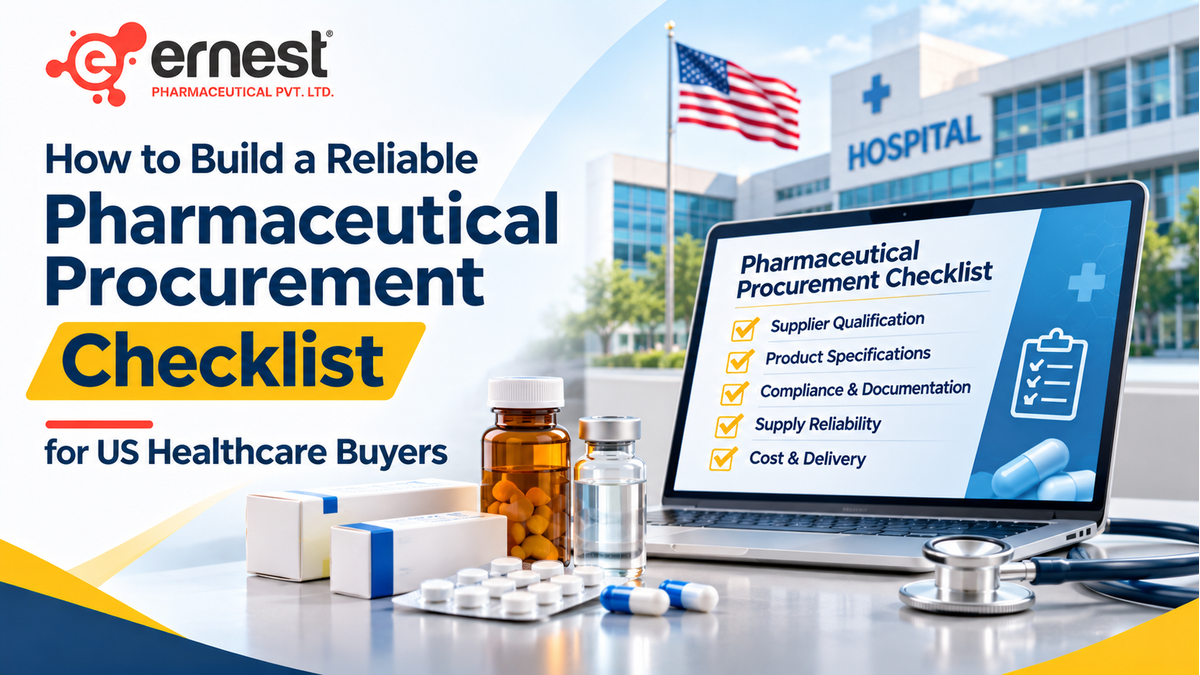
How to Build a Reliable Pharmaceutical Procurement Checklist for US Healthcare Buyers
1. Introduction
Buying pharmaceuticals is more than simply comparing the prices of
medicines and selecting a supplier. U.S. healthcare buyers must review
product specifications, supplier credentials, quality documentation,
regulatory requirements, delivery arrangements and total cost of
procurement before confirming an order.
Missing documents, unclear product specifications or unreliable supplier
arrangements can cause problems during purchasing, importation, storage
and distribution. These issues may also impact inventory planning and
continuity of supply.
A pharmaceutical procurement checklist USA provides a structured way for
healthcare buyers to review these considerations before making
purchasing decisions. It helps procurement teams to organize product
requirements, evaluate suppliers, coordinate quality reviews, compare
quotations and document purchasing approvals.
For hospitals, pharmacies, pharmaceutical distributors, importers and
healthcare procurement organizations, a reliable checklist should cover
the complete purchasing process rather than focusing on price or
documentation alone.
The aim of this guide is to help US healthcare buyers build a realistic
pharmaceutical procurement checklist, what information to review at each
stage and how to coordinate procurement with quality, regulatory and
logistics teams.
1. Drug Product Requirement means
The first step in the pharma buying process is to determine exactly what
the organisation's requirements are. If the specifications of the
purchase request are incomplete or unclear, the suppliers cannot provide
accurate quotations and confirm the suitability of the products.
Procurement teams should develop a detailed product requirement before
reaching out to suppliers.
Purchase Request Details
- Generic Name: Give the proper generic or established name of the medicine
- Brand name: If any, indicate a preferred brand.
- Strength: Indicate strength requirement and unit of measure.
- Dosage form: Determine whether the requirement is for tablets, capsules, injections,
creams, solutions or other dosage forms.
- Route of administration: Include the intended route where relevant to the product
identification.
- Pack configuration: State the number of units needed, the pack
size and presentation.
- Quantity: Indicate the needed quantity and the anticipated ordering frequency.
- Manufacturer preference: Determine if there are any approved orpreferred manufacturer requirements.
- Storage conditions: Indicate any temperature, humidity, light or
other handling requirements.
- Delivery destination: Check receiving location and estimated delivery time.
For instance, a request for an injectable medicine should not merely
refer to the product name. It should also specify the strength required,
dosage form, pack configuration and quantity.
Well-stated specifications enable the purchasing team to compare similar
products and help to avoid misinterpretations at the quotation and order
acknowledgment stages.
Check demand and inventory needs
Also, product requirements should be aligned with actual purchases. If
you order volumes without looking at demand and existing stock, you
increase the risk of overstock, expiry losses or unnecessary procurement
costs.
Purchase request review prior to submission:
- Present stock availability.
- Historical patterns of use.
- Anticipated demand at the time of purchase.
- Orders in place, deliveries to come.
- Inventory minimum and maximum limits.
- Expected remaining shelf-life and expiry of the product.
- Lead times and potential supply disruptions.
The demand planning process should involve the relevant pharmacy,
inventory or materials-management team so that the purchase quantity
matches operational requirements.
2. Evaluate the Pharmacy Provider
US healthcare procurement checklist features supplier assessment as a
key component. A competitive quotation does not indicate that a supplier
is suitable for a pharmaceutical transaction.
Buyers need to know who they are buying from, what the organization does
and whether it can support the specific product and transaction.
Confirm Identity of Supplier
Collect and analyze relevant business information, including:
- Registered name of a legal business.
- Business address and contact details.
- Company registration details (if applicable).
- Name and Role of the Authorized Business Contact.
- the identity of the actual producer of the product.
- Relationship with the supplier-manufacturer.
- Any middlemen in the supply chain.
If the supplier is a distributor, agent or trading company rather than
the manufacturer the buyers should establish the identity of the
original manufacturer and the supply arrangement.
Check Relevant Licences and Regulatory Registrations
Required regulatory checks are based on the supplier's activities, the
type of product, and the role of the product in the U.S. pharmaceutical
supply chain.
Buyers should determine the federal and state requirements applicable to
the proposed transaction. For example, there may be applicable licensing
and reporting obligations for wholesale drug distributors and
third-party logistics providers.
FDA establishment registration requirements also apply to relevant
manufacturing, repacking, relabeling or salvaging establishments. FDA
registration and drug listing do not constitute evidence of FDA approval
of a medicine.
The FDA has information on establishment registration requirements in
its official guide: How to Register a Drug
Establishment.
Determine Supplier Reliability
The ability of the organization to provide consistent service and to
respond to supplier assessment issues should be considered.
Consider checking out:
• Experience within the relevant pharmaceutical product category.
- Availability of the requested products.
- Verifiable past performance of supply.
- Turnaround and communication time.
- Ability to provide correct product and quality documentation.
- Estimated timelines for leads and delivery schedules.
- Procedures for dealing with shortages, delays and product
- complaints.
- Access to adequate supply-chain traceability information.
In the course of assessing a supplier, it is necessary to evaluate the
risks and requirements of the proposed acquisition and not rely on
general statements of the company.
3. Check the Quality of the Product and the Documents
Product documentation helps buyers understand what they are buying, who
made it, and what quality information is available.
The specific documents to be provided will vary depending on the
product, transaction, the relevant regulations and the roles of the
parties involved.
Pharmaceuticals Documents To Look At
Where applicable, a procurement checklist may include the following
records:
- TECHNICAL INFORMATION OR SPECIFICATION OF PRODUCT
- Manufacturer and manufacturing site information.
- Certificate of Analysis (CoA) for the lot, if applicable.
- GMP documentation applicable.
- Information on product labeling and packaging.
- Lot and batch identification details.
- Expiration and manufacturing dates, where appropriate.
- Stability and/or storage information, if available.
- Relevant regulatory and product authorization information.
- Shipping, handling and record of traceability;
Procurement teams should not assume that every document is relevant for
every medicine. The definition of the product and transaction
documentation requirements should be the responsibility of the quality
and regulatory teams.
Confirm the Certificate of Analysis
Certificate of Analysis A Certificate of Analysis is a document which
details the testing that has been performed on a specific batch of a
pharmaceutical product or material.
When reviewing a CoA, make sure you review:
- Identity of material or product.
- Laboratory or manufacturer issuing it.
- Batch/Lot number.
- Specifications and acceptance criteria applicable.
- analytical methods where available.
- Real test results where applicable.
- Manufacturing, expiry or re-test details as applicable.
- Acceptance of authenticity and quality of documents.
The CoA should be for the batch being supplied. Any differences in
product identity, batch number or reported information should be
clarified.
Read the related guide: Certificate of Analysis in Pharmaceutical
Procurement: What US Buyers Should
Review
4. Check applicable U.S. regulatory requirements
What is the regulatory review for pharmaceuticals purchased in or
through the United States? A regulatory review is conducted on a
product-by-product basis. Buyers should not assume that a product can be
imported, marketed or distributed because a supplier has provided a
certificate or general compliance statement.
The regulatory assessment will take into account the medicine, its
intended use, the organizations involved and the proposed transaction.
Establishment Registration and Drug Listing with the FDA
Buyers should identify manufacturing or other establishments involved,
if applicable. Buyers should review relevant FDA registration and drug
listing information.
FDA states, "Certain establishments that manufacture, repack, relabel or
salvage drugs for distribution in the United States must register with
FDA, subject to applicable exemptions."
It is also useful to know the limitations of these records. FDA reminds
that establishment registration and drug listing are not an approval by
FDA of a product or an FDA verification of the information submitted.
Official references that are useful:
Understand the supply chain requirements that count
The Drug Supply Chain Security Act (DSCSA) requires tracing of certain
prescription drugs as they move through the pharmaceutical supply chain
in the United States.
Depending on the role and the products, manufacturers, repackagers,
wholesale distributors and dispensers may have specific obligations.
Buyers should consider if the relevant trading partners and distribution
arrangements meet the requirements applicable to their activities.
See the official FDA Drug Supply Chain Security Act (DSCSA)
information.
Check Product Eligibility & Import Eligibility
Before confirming an international purchase, buyers should determine
whether the specific product and proposed transaction comply with
applicable US import and marketing requirements.
This review shall not be a substitute for a general supplier
declaration, product catalog or FDA establishment registration record.
For more information, please visit US Pharmaceutical Import Documents:
Buyer
Checklist.
5. Comparison of quotations from suppliers and overall purchasing costs
Price comparison is a major buying action, but the lowest price may not
always be the most suitable procurement option.
Buyers of healthcare should seek quotes on products of the same
specifications and purchasing requirements.
What to Compare on a Pharmaceutical Quote
- Name, strength and dosage form of the product.
- Presentation of the manufacturer and of the product.
- Total quantity and pack size.
- Quoted unit price and total amount.
- Minimum order quantity (MOQ).
- Inventory on hand and on order.
- There are still Shelf life requirements.
- Currency and payment terms.
- Delivery charges and insurance if applicable.
- Expected shipping and delivery dates.
- applicable taxes, duties and other transaction costs;
- The quotation validity term.
Total Landed Cost Calculation
The price you pay for a pharmaceutical from another country may not be
the total cost of getting the product.
The buyer may need to consider, depending on the transaction:
- Price of the product.
- Cost of freight and transportation.
- Goods insurance.
- applicable taxes & customs duties.
- Handling and customs clearance charges.
- Storage and temperature controlled logistics costs.
- Other expenses specific to the transaction.
The total landed cost shall be assessed in accordance with the
applicable commercial terms and import arrangements.
Reasonable comparison should take into account product suitability,
documentation, supplier reliability, delivery arrangements and total
cost together.
6. Storage, Delivery Arrangements and Logistics Review
Once a supplier has confirmed availability of a product, the buying
process is not over. Buyers also need to know how the medicines will be
stored, handled and delivered.
• Transportation needs should be appropriate for the product and the
expected distribution route.
Logistics checklist
Kindly review prior to confirming the order:
- Dispatch destination and place.
- Estimated dates of dispatch and delivery.
- Means of transport and route.
- Storage conditions of the product.
- Procedures for packaging and handling.
- Temperature monitoring requirements, if applicable.
- Arrange shipment communication and tracking.
- Customs and documentation requirements.
- Procedures for delays, damaged packages or delivery discrepancies.
- Arrangements for receipt and inspection.
Buyers should make sure that the proposed packaging and transportation
arrangements are appropriate for temperature sensitive medicines.
The receiving facility should also have sufficient storage capacity and
a defined procedure for checking the received shipment.
7. Confirm Purchase Order Terms & Internal Approvals
Once the product requirements, supplier information, documentation,
regulatory considerations and quotes have been reviewed, the
organization can move to purchase approval.
The purchase order should be a true representation of the agreed
transaction.
PO Information
Generally, a purchase order should specify:
- Legal names of buyer and supplier.
- Date and order number.
- Name and description of the product.
- Potency, dosage form and package size.
- Manufacturer (if relevant).
- Price per unit and amount to order.
-Total order value and currency.
- Delivery Place As agreed.
- Anticipated delivery timeframe.
-Payment terms.
- Relevant product and documentation requirements.
- Agreed commercial and delivery terms.
Create an Approval Process
Procurement approval should be in accordance with the organisation's
internal purchasing policies.
Depending on the product and the purchase value, the review may include:
- Procurement/Purchasing team.
- Clinical or Pharmacy Representative.
- Quality assurance group.
- Team of regulatory affairs.
- Finance or Accounting department.
- Inventory/Warehouse Management.
- Approved purchaser.
Commercial approval and technical quality approval should be separate
where the organisation's procedures require separate responsibilities.
Acceptance of a quotation does not constitute approval of product
quality or regulatory acceptability.
8. Confirm Receiving and Documentation Records of Delivery
After the procurement teams have dispatched the shipment, they should
track its progress and liaise with the receiving organization.
During the delivery process the purchase order, supplier documents and
the goods received must be checked.
Rcvng Checklist
- Check supplier and purchase order reference.
- Check the name and strength of the product delivered.
- Confirm the dosage form and pack configuration.
- Check the quantity received.
- Verify the batch or lot identification.
- Check expiry dates, remaining shelf life.
- Inspect packaging for any visible damage or discrepancies.
- Review related quality and shipment documents.
- Check relevant storage and temperature records.
- Note any shortages, discrepancies or damaged goods.
- Raise quality issues through the appropriate procedure.
Any discrepancies between the products ordered and those received must
be documented and investigated prior to accepting the goods into regular
inventory.
If a quality concern is identified, the product should be handled in
accordance with the organisation's established quality procedures.
9. Monitor Vendor Performance After Procurement
A reliable process of pharmaceutical procurement should involve supplier
performance reviews after the order is completed.
A supplier that can meet a single delivery requirement may not
necessarily provide consistent service for future orders.
Healthcare purchasers can track supplier performance using measurable
criteria.
Areas to Review Supplier Performance
Product and documentation accuracy
Is the supplier consistently providing the correct product, agreed
specifications and the relevant documentation?
Delivery on time
Record whether deliveries are on schedule as agreed and whether delays
are being communicated properly.
Talk
Check the supplier's speed of response to questions on purchasing,
documentation and delivery.
Processing orders
Check for shortages, substitutions, incorrect quantities, and other
discrepancies in order.
Issues concerning quality
Document product complaints, documentation discrepancies, and other
concerns that need to be investigated.
Commercial performance
Verify the accuracy of the quotation, agreed pricing, payment terms and
any unexpected charges.
Procurement teams can utilize supplier performance records to spot
patterns of problems and decide whether further review or corrective
action is required.
10. Make a Realistic Checklist for Pharmaceutical Procurement
The following US healthcare procurement checklist brings together the
main purchasing stages in one review format.
USA Pharmaceutical Procurement Checklist
- Product requirement: Generic name, strength, dosage form and
- packsize. Review status: Incomplete/Complete
- Quantity planning: Demand, stock on hand, and required quantity.
- Review Status: Pending / Completed.
- Supplier identity: Legal company information and manufacturer
- affiliation. Review Status: Pending / Done.
- Supplier credentials: Business records, relevant licenses and
- registrations. Review Status: Done / Not Done.
- Product documentation: specifications, labels and other product
- information. Review status: pending/complete
- Quality review: CoA and other relevant quality documentation.
- Review Status: Pending/Complete.
- Regulatory review: US applicable requirements and product
- eligibility. Review status: Completed/Pending.
- Quotation review: Price, MOQ, payment terms & validity of
- quotation. Review Status: Pending / Completed.
- Cost evaluation: Cost of freight, insurance, duties and other
- applicable charges. Review Status: Completed / Pending
- Logistics: Organize storage, handling, transport and delivery.
- Review Status: Pending/Completed
- Purchase authorisation: Internal review and sign off. Review
- Status: Pending/Approved.
- Purchase order: Product, quantity, price and terms of delivery.
- Review Status: Pending/Completed.
- Receiving: Check quantity, product identity, batch and
- packaging. Review Status: In Progress / Done.
- Post purchase review: Supplier performance and issue history.
- Review Status: To Be Reviewed / Finished.
The checklist should be adapted to the company's purchasing policies,
product category, transaction risk and applicable regulatory
requirements.
A checklist is not a substitute for formal quality, regulatory or legal
approval where required.
11. Pharmaceutical Procurement Mistakes to Avoid
But even the best process can fall down if key checks are missed.
Choosing a Supplier Based on Cost Only
The low quote might not have the proper documentation or the right type
of delivery or the level of supplier support that you need. Before you
decide, compare all the buying needs.
Using Partial Product Specifications
Missing information about the strength, dosage form, pack size or
manufacturer can lead to incorrect quotations and order discrepancies.
Once the product requirement is defined, contact the suppliers.
Accepting Documents Not Yet Verified
A document should be examined for consistency and authenticity where
appropriate. Buyers should not take a certificate provided by a supplier
at face value as indicating product approval or regulatory compliance.
Discard Date
The product may be received with a shorter usable shelf life than
expected. The buyer should have reasonable expectations of shelf-life
before confirming the purchase.
Ignoring Logistics Requirements
avoidable supply-chain problems can arise from incorrect storage,
unsuitable packaging or unclear delivery responsibilities. Confirm
receiving and handling procedures prior to shipment.
Skipping Supplier Performance Checkups
Without supplier records, procurement teams can find themselves dealing
with the same delivery, documentation and communication issues time and
time again.
A structured purchasing process helps organizations to identify these
issues earlier and improves consistency in future orders.
Conclusion
A strong pharmaceutical procurement checklist is created with a joint review of product specifications, supplier qualifications, quality records, regulatory aspects, commercial terms and logistical agreements.
The pharmaceutical procurement checklist USA approach should cover
the entire purchasing process for US healthcare buyers, from defining
medicine needs and evaluating suppliers to approving purchase orders,
receiving products and monitoring supplier performance.
Procurement teams should also collaborate with quality assurance,
regulatory affairs, finance and inventory departments to ensure that
commercial decisions are supported by the appropriate technical and
operational reviews.
A well maintained checklist can help make the pharma purchasing process
more organized, improve consistency of documentation and help buyers
identify possible problems before they impact supply.
Frequently Asked Questions (FAQs)
1. What should be in a pharmaceutical procurement checklist?
The pharmaceutical procurement checklist should include product
specifications, supplier identity, applicable credentials, quality
documents, regulatory checks, quotation comparison, logistics
arrangements, purchase approvals, receiving procedures and supplier
performance reviews.
2. Why is a pharmaceutical procurement checklist important for US healthcare buyers?
It offers a structured way of scrutinizing purchasing requirements and
identifying potential problems concerning product specifications,
supplier reliability, documentation, regulatory responsibilities and
delivery arrangements prior to the confirmation of an order.
3. How can buyers in the US healthcare sector evaluate a pharmaceutical supplier?
Buyers can check the legal identity of the supplier, business
credentials, relationship with the manufacturer, applicable licenses,
product documentation, quality information, delivery capabilities and
capability to provide traceability information.
4. What documents should buyers require from pharmaceutical suppliers?
Buyers may request product specifications, manufacturer details,
batch-specific Certificates of Analysis, applicable GMP-related records,
product labeling, batch information and relevant shipping or regulatory
documentation, depending on the product and transaction.
5. FDA establishment registration does not mean that a drug is FDA approved.
No. FDA establishment registration and drug listing are not evidence
that a medicine has FDA approval or that FDA has verified the
information submitted. Buyers should verify the regulatory status of the
particular product.
6. How can buyers compare quotes from pharmaceutical vendors?
Buyers need to compare the equivalent product specifications,
manufacturer, quantity, pack configuration, unit price, MOQ, payment
terms, delivery time and other applicable costs. Any international
purchases should be evaluated based on the relevant total landed cost.
7. Things to check before accepting a pharmaceutical delivery?
Receiving teams should check the purchase order, product identity,
strength, dosage form, quantity, batch details, expiry details,
packaging condition and any relevant quality or temperature records. If
any difference it should be noted and escalated through the proper
procedure.
8. Pharmaceutical suppliers should be regularly audited.
Supplier reviews should be consistent with the organisation's quality
and procurement procedures. The frequency and depth of review may vary
based on supplier risk, product criticality, purchasing activity,
performance history and applicable requirements.
To Pharma B2B Buyers
Reliable pharmaceutical procurement requires clear product requirements, transparent supplier communication and appropriate documentation at every stage of purchasing.
Ernest Pharmaceuticals makes information available on its pharmaceutical products and business operations on its official website. If you are a buyer interested in pharmaceutical sourcing you can browse the list of available information and contact the company to discuss your product and business needs.For company and product information, visit Ernest
Pharmaceuticals.
Quality and Regulatory Disclaimers
This article is for general educational and informational purposes only. It does not constitute legal, medical, regulatory customs or professional purchasing advice. Pharmaceutical product requirements,Supplier responsibilities, FDA requirements, State licensing obligations and Import conditions may differ depending on the product, transaction and organizations involved. FDA establishment registration or drug listing shall not be construed as evidence that the product has been approved by FDA. Buyers should independently verify applicable requirements and seek the advice of qualified legal, regulatory, quality and pharmaceutical professionals before making purchasing, importation or distribution decisions.